


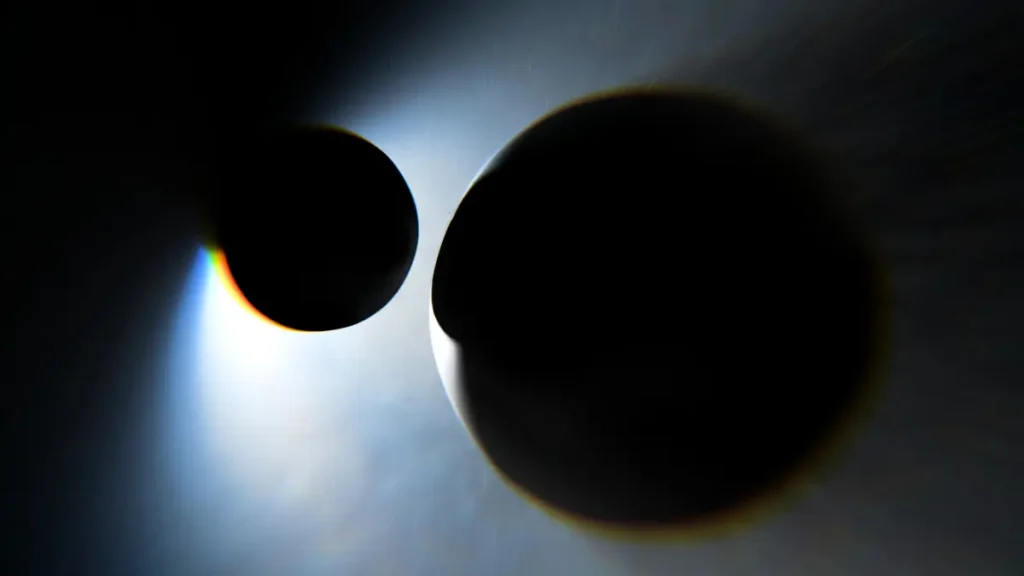
In an extraordinary breakthrough, scientists have observed two black holes collision events that have given the most precise validation of Einstein’s theory of relativity ever recorded.
These twin cosmic events, detected by the LIGO, Virgo, and KAGRA observatories, sent ripples through the very fabric of space-time — known as gravitational waves — and confirmed once again that Einstein’s century-old equations still hold true, even under unimaginable conditions.
What Happens When Two Black Holes Collide
A two black holes collision occurs when two massive black holes, each millions of times heavier than our Sun, spiral toward each other due to gravitational pull.
As they merge, they release enormous amounts of energy — equivalent to several suns converting entirely into pure gravitational radiation in just seconds.
During this recent discovery, scientists observed two such nearly identical mergers.
Both collisions produced strong, clean gravitational wave signals that matched Einstein’s theoretical predictions exactly.
“This was like listening to the heartbeat of the universe — and Einstein’s rhythm remains perfect,” said Dr. Laura Jenkins, an astrophysicist with the LIGO team.
The Science Behind Einstein’s Theory
When two black holes collide, they disturb the surrounding space-time, creating gravitational waves that stretch and compress the universe as they pass through.
LIGO and Virgo detect these distortions using laser interferometers, which can measure changes thousands of times smaller than an atom’s width.
In this case, the twin black hole mergers produced data so precise that scientists could analyze every tiny fluctuation of the waves — and the results showed no deviation from Einstein’s equations of general relativity.
That means gravity behaves exactly as Einstein predicted, even in the violent aftermath of a cosmic collision.
How the Observation Was Made
The two black holes collision events were recorded at separate times and locations, yet both shared nearly identical characteristics:

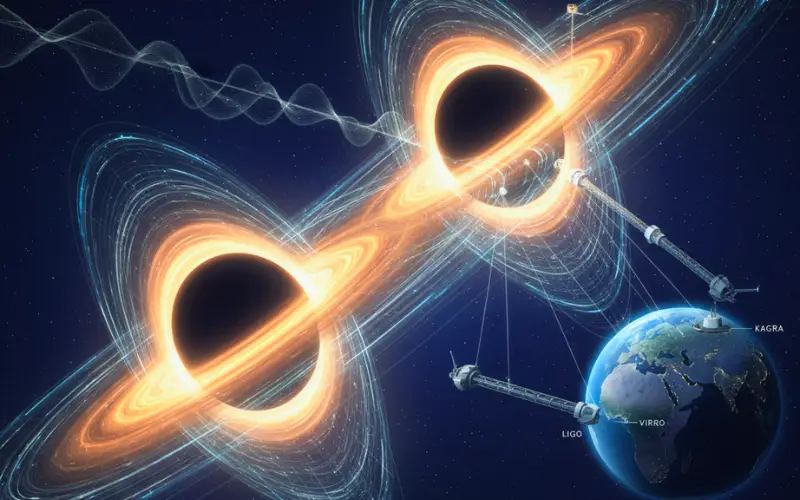
- Each involved two rapidly orbiting black holes merging into one.
- Both released gravitational waves strong enough to reach Earth.
- And both followed the same space-time distortion pattern predicted by general relativity.
By comparing these twin events, scientists were able to confirm — with unmatched accuracy — that Einstein’s model still holds true after more than a century.
“If relativity were ever to fail, this is where we’d expect to see it — and yet, it passed flawlessly,” said Dr. Akira Tanaka, from the KAGRA Observatory in Japan.
Why This Discovery Matters
The confirmation of Einstein’s theory through two black holes collision carries enormous importance for astrophysics and our understanding of the universe:
- Tests Gravity at Its Limit: These collisions occur in regions with gravity billions of times stronger than on Earth — proving relativity works even at cosmic extremes.
- Refines Black Hole Physics: Each observation helps scientists model how black holes spin, merge, and stabilize after colliding.
- Rules Out Alternative Theories: Competing theories predicting variations in space-time behavior were once again disproven.
- Advances Gravitational Astronomy: Every new detection strengthens our ability to use gravitational waves as tools for exploring the hidden universe.
Einstein’s Relativity: Still Unbroken
Einstein’s general relativity explains how mass bends space and time, and how gravity isn’t a pulling force but the result of that curvature.
In everyday life, it governs planetary orbits and GPS satellites; in the depths of space, it dictates the fate of stars, galaxies, and black holes.
Despite countless experiments and observations over the last 110 years, no evidence has ever disproven it — and this latest two black holes collision adds yet another powerful confirmation.
A Global Effort to Observe the Unseen
The detection involved international collaboration between observatories in the United States, Italy, and Japan.
Together, their detectors form a network capable of pinpointing the direction of gravitational waves arriving from billions of light-years away.
This global teamwork has transformed astronomy from light-based observation to multi-messenger exploration, combining light, particles, and gravitational waves to study the cosmos from every angle.
The Future of Two Black Holes collision Research
The twin collisions observed this year are only the beginning.
Future space-based detectors, such as LISA (Laser Interferometer Space Antenna) — expected to launch in the 2030s — will expand our ability to detect even fainter gravitational waves from supermassive black hole mergers and perhaps even from the early universe itself.
Scientists hope that with more advanced technology, they might one day detect tiny irregularities in gravitational wave patterns — potential clues to a deeper, unified theory that connects relativity and quantum physics.
Disclaimer: Einstein’s theory stands unchallenged as new black hole collisions reveal gravity and space-time behave exactly as predicted.

