


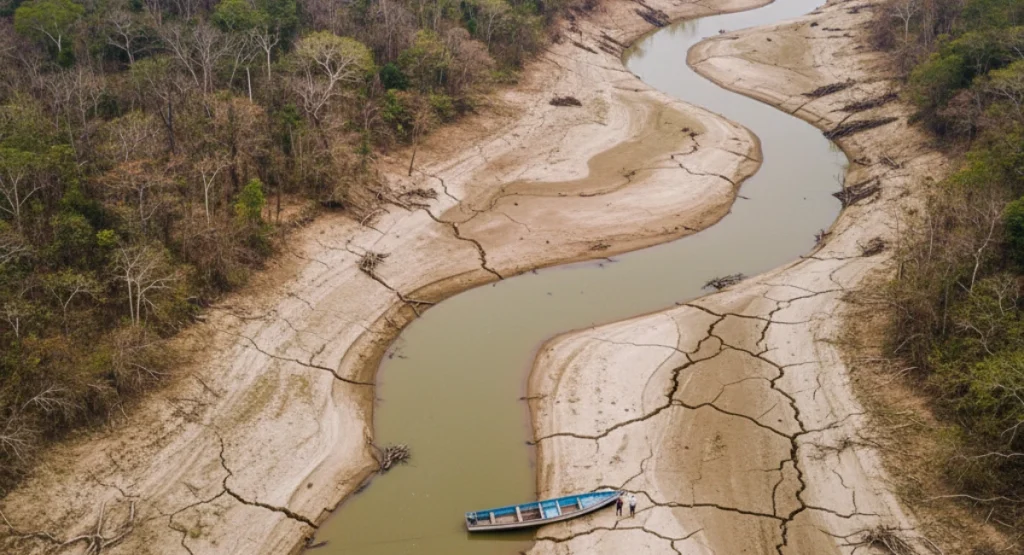
Scientists warn the world’s largest rainforest is approaching a “point of no return” as Brazil prepares to host COP30 in Belém next year. Droughts, fires, and rising heat are pushing the Amazon toward an irreversible shift.
A Warning We Cannot Ignore
When I looked at the latest satellite images of the Amazon, I felt something was very wrong. Rivers that were always wide and full now look like thin blue lines. Huge areas of forest are covered in smoke.
Scientists are calling this a serious warning: the Amazon Rainforest may be crossing an irreversible climate tipping point.
And this is happening just as Brazil prepares to host COP30 in Belém in 2025, right in the heart of the Amazon.
Experts say the world must act now, because the window to protect the rainforest is closing fast.
What Scientists Are Seeing Right Now
Recent scientific reports show a sudden increase in danger signs:
- Parts of the Amazon are releasing more carbon than they absorb.
- The region faced one of the worst droughts ever recorded in 2023–24.
- Fires have doubled in many areas.
- Rivers in Amazonas hit their lowest water levels in history.
One researcher said,
“We are dangerously close to losing the Amazon as we know it.”
As someone who follows climate news daily, I can feel how often the phrase “tipping point” is appearing. And every time it shows up, the situation gets more serious.
What Is a “Tipping Point” ?
A tipping point means a moment when change becomes self-accelerating.
In simple words:
once the forest loses enough trees, it cannot recover again — even if we stop cutting it.
Here’s why :
- The Amazon creates its own rain.
- When trees die, rainfall drops.
- When rainfall drops, more trees die.
- The cycle repeats until the forest turns into dry grassland.
Scientists say the tipping point may occur after 20–25% forest loss.
The Amazon has already lost around 17–18%, and many areas are badly degraded.
This means the danger zone is very close.
Why the Amazon Matters to Everyone
The Amazon is not only Brazil’s treasure — it protects the whole planet.
Here’s why it matters:
- ✔ It stores over 100 billion tons of carbon, slowing global warming.
- ✔ It produces 25–50% of its own rain, feeding farms and cities across Brazil.
- ✔ It is home to 10% of all known species on Earth.
- ✔ More than 30 million people depend on its rivers and forests.
Personally, I often think about how many things around us — coffee, food, clean air — are connected to this forest we may never visit but truly need.
The Evidence From the Ground
The latest reports from inside the Amazon show a crisis developing fast :
- The Negro River in Manaus reached its lowest level ever measured.
- Boats carrying food and medicine were stuck on dry riverbeds.
- Forest fires increased sharply in Pará, Acre, and Amazonas.
- Certain forest areas turned into carbon sources, not sinks.
The Amazon’s Rio Negro has hit its lowest level in 120 years — a powerful sign of a deepening climate crisis.
One Indigenous leader said,
“The forest is sick, and we feel the sickness in our bodies.”
These stories show that the Amazon is not only fighting climate change — it is suffering from it.
The Human Impact Is Growing
During my earlier visits to rural Brazil, many farmers told me the same thing:
“ The rain is coming late.”
This year, the situation became worse.
Because of extreme heat and smoke :
- Hospitals reported more asthma and breathing problems.
- Children and the elderly suffered most.
- Many communities near Manaus had to travel hours to find clean drinking water.
- Hydropower output dropped in some states.
This tipping point is not just about trees.
It is also about people, homes, health, and daily life.

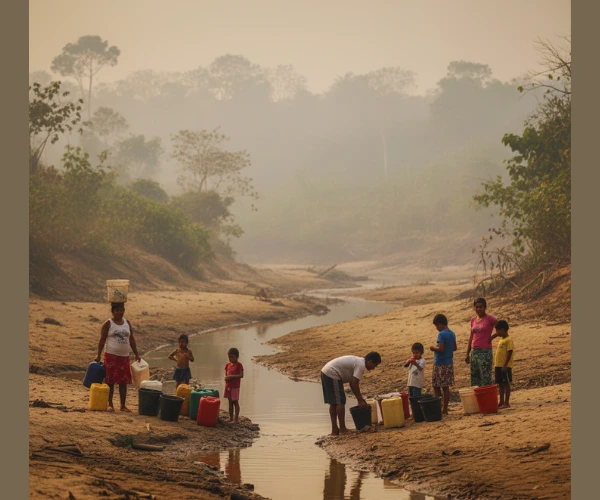
Families collect water from a shrunken river in the Amazon as drought and smoke from nearby fires disrupt daily life.
The Road Toward COP30 — Why It Matters
In 2025, the world’s biggest climate summit — COP30 — will take place in Belém, Pará, inside the Amazon region as reported in a detailed Reuters update on the COP30 opening.
This is historic.
It means world leaders will be discussing climate action while standing inside the rainforest that is nearing collapse.
Brazil has promised:
- Zero illegal deforestation by 2030
- New rules for sustainable farming
- Stronger protection for Indigenous lands
COP30 can become the moment when world countries decide if the Amazon will survive or fall into a dangerous loop.
As I see it, COP30 is like the Amazon’s emergency meeting with the world.
Can the Trend Be Reversed ?
Scientists say we still have time — but not much.
Here are the actions that can help :
✔ 1. Stop illegal deforestation
Better law enforcement and satellite monitoring are essential.
✔ 2. Restore damaged forests
Even partial recovery brings back rainfall.
✔ 3. Strengthen Indigenous land rights
These lands have the lowest deforestation rates in the entire Amazon.
✔ 4. Reduce fires through community-based programs
Controlled burns and early fire detection saves huge areas.
✔ 5. International support
Countries buying soy, beef, timber must ensure clean, deforestation-free supply chains.
I personally believe that even small actions — supporting sustainable brands, planting trees, spreading awareness — can help balance the system.
How Other Climate Systems Affect the Amazon
The Amazon tipping point is linked with other global climate problems :
- Melting Greenland affects Atlantic Ocean currents.
- Those currents affect rainfall in the Amazon.
- Dry Amazon forests release more carbon.
- More carbon heats the planet.
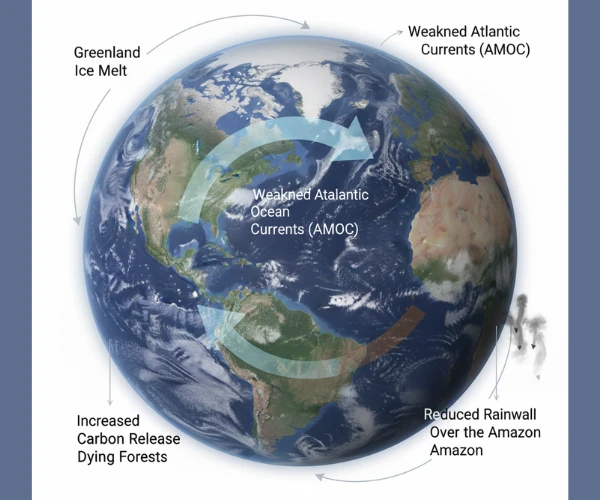
A scientific graphic showing how Greenland melt, weakened Atlantic currents, and Amazon drying are linked in a global climate feedback loop.
Experts call this the “climate doom loop.”
In simple words :
If one part of Earth passes a tipping point, others start falling too.
Final Thoughts
Writing this article made me realize one thing:
the Amazon’s future is our future.
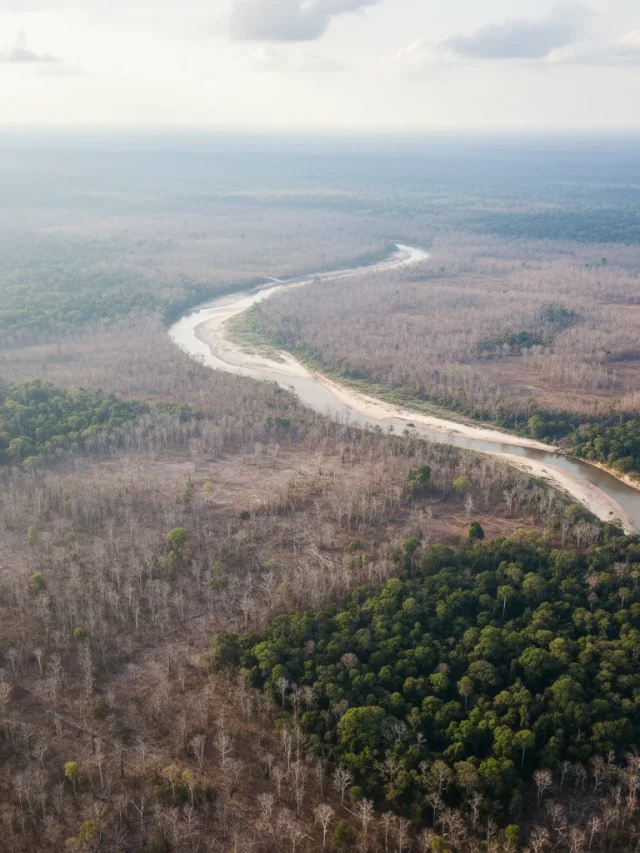
The rainforest is sending signals — dropping rivers, dying trees, silent animals, orange skies filled with smoke.
If we act now, the forest can still heal.
If we wait, the shift may become permanent.
And once the Amazon crosses the tipping point, there is no reset button.
What the world does before COP30 will decide the path ahead.


Disclaimer :
All information in this article is sourced from recent scientific studies and official climate agencies. Data may evolve with new research.


Contents
- 1 Scientists warn the world’s largest rainforest is approaching a “point of no return” as Brazil prepares to host COP30 in Belém next year. Droughts, fires, and rising heat are pushing the Amazon toward an irreversible shift.
- 2 A Warning We Cannot Ignore
- 3 What Scientists Are Seeing Right Now
- 4 What Is a “Tipping Point” ?
- 5 Why the Amazon Matters to Everyone
- 6 The Evidence From the Ground
- 7 The Human Impact Is Growing
- 8 The Road Toward COP30 — Why It Matters
- 9 Can the Trend Be Reversed ?
- 10 How Other Climate Systems Affect the Amazon
- 11 Final Thoughts
- 12 Disclaimer :