


Have you ever looked up at the night sky and seen that bright, golden planet glowing beside the stars — Jupiter? It might look distant and calm, but that planet is quietly protecting us from destruction. Scientists say that without Jupiter’s protection, Earth might not even exist today.
Let’s explore how this giant planet, hundreds of millions of kilometers away, keeps our fragile world safe — like a cosmic shield guarding life itself.
The Giant That Shapes Our Solar System
Jupiter isn’t just the largest planet; it’s the gravitational anchor of our Solar System.
Weighing more than 300 times the mass of Earth, it has a pull so powerful that it stabilizes the orbits of neighboring planets, including ours.
Astronomers often call Jupiter the “vacuum cleaner” of the Solar System — because it sucks in or deflects dangerous asteroids and comets that could otherwise collide with Earth.
In fact, without this massive guardian, scientists believe that Earth might have been bombarded by constant cosmic debris, making life impossible to begin with.
“Jupiter is not just a planet,” said planetary scientist Kevin Grazier, “it’s the reason we’re still here.”
The Great Cosmic Shield: How Jupiter Saves Us From Asteroids


To understand Jupiter’s protection, think of it like a giant magnet pulling deadly space rocks away from Earth.
Every year, thousands of asteroids travel through the inner Solar System — some large enough to wipe out entire continents.
But Jupiter’s immense gravity captures or redirects many of these objects before they come anywhere near Earth’s orbit.
One famous example happened in 1994, when the comet Shoemaker-Levy 9 slammed into Jupiter’s atmosphere instead of Earth.
If it had struck our planet, it could have caused an extinction-level event similar to what killed the dinosaurs.
That one event alone shows how Jupiter literally takes the hit for us.
Keeping Earth’s Orbit Stable
Jupiter’s protection isn’t limited to deflecting asteroids — it also helps stabilize Earth’s path around the Sun.
Without it, our planet’s orbit would wobble chaotically over millions of years.
Simulations show that if Jupiter didn’t exist, Earth could eventually drift too close to the Sun, turning into a scorched, lifeless rock.
Or it might swing too far out, freezing over completely.
In other words, Jupiter keeps Earth in the perfect zone for life — not too hot, not too cold.
A recent NASA simulation confirmed that Jupiter acts as a “gravitational regulator,” maintaining harmony among the planets.
The Dual Nature of a Giant
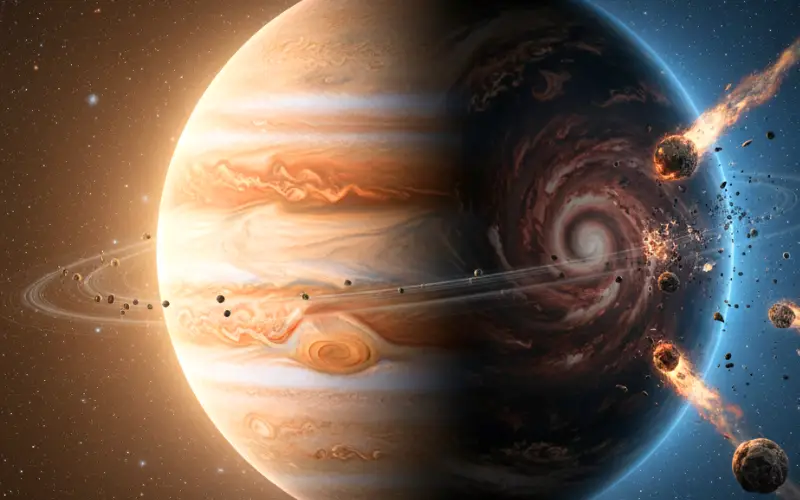
Of course, Jupiter isn’t all good news.
Its gravity can sometimes disturb smaller asteroids and send them hurtling toward the inner Solar System — including Earth.
But even then, most of those objects are small and harmless compared to what Jupiter prevents.
So, while Jupiter occasionally plays the villain, its overall role in our Solar System remains overwhelmingly protective.
It’s a cosmic paradox — both destroyer and savior — but one that ultimately ensures our planet’s survival.
The Science Behind Jupiter’s Gravitational Influence
To grasp how Jupiter’s protection works, picture space as a giant pool of water.
Every planet creates ripples — but Jupiter’s ripples are huge, dominating the pool.
Those gravitational “waves” can trap or redirect smaller objects before they enter Earth’s orbit.
Scientists study these gravitational interactions using advanced computer models.
The results consistently show that Jupiter acts as a stabilizing force, reducing the number of catastrophic impacts on Earth by up to 90% since the early days of the Solar System.
Without it, our planet’s surface might have been pummeled so often that complex life could never evolve.
What If Jupiter Suddenly Disappeared?
It’s a terrifying thought experiment — what if Jupiter vanished overnight?
Within a few centuries, the entire Solar System’s balance would begin to unravel.
Earth’s orbit might slowly change shape, increasing seasonal extremes.
Comets and asteroids from the outer regions would flood inward.
Within millions of years, Earth could either collide with another planet or spiral into the Sun.
In short, Jupiter’s absence would spell cosmic chaos.
Our blue planet owes its calm skies and predictable seasons to that distant, stormy giant.
The Guardian We Rarely Notice
When you gaze at Jupiter tonight, remember: it’s more than a planet; it’s a protector, stabilizer, and silent guardian.
For billions of years, it has shielded Earth from destruction, guided the evolution of life, and kept our world steady in the vast cosmic ocean.
In a universe full of danger and unpredictability, Jupiter’s protection reminds us that even the fiercest giants can play the gentlest roles — ensuring that our small, fragile world continues to shine under the Sun.
Disclaimer: This article is for educational purposes only. Information is based on NASA and verified scientific sources. It should not be taken as professional advice; readers are encouraged to refer to official research for detailed insights.