


A closer look at the subtle climate shift that slowed momentum, reshaped policy, and changed the global outlook in 2025
Climate action did not fail in 2025.
It did not collapse either.
But something important changed.
Across many regions, climate progress slowed down instead of speeding up. Policies were delayed. Targets were softened. Momentum quietly shifted. This change did not arrive with dramatic headlines, but climate data shows a clear pattern: progress stalled in subtle but meaningful ways.
This quiet reversal matters more than it may seem.
What Changed in 2025 — A Climate Shift Few Expected
For years, climate action was moving in one clear direction: faster goals, stronger commitments, and bigger promises. In 2025, that direction became less certain.
Instead of bold new steps, many governments and institutions paused. Some adjusted timelines. Others focused on economic stability over climate speed. This created a global climate shift that felt slow but widespread.
This was not a sudden breakdown.
It was a climate momentum slowdown.

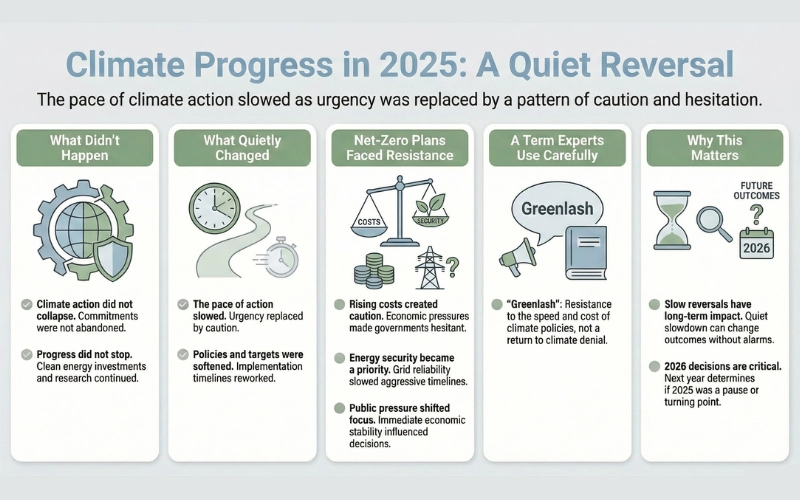
A visual summary of how climate momentum slowed in 2025 without a dramatic collapse.
Climate Action Slowed, Not Stopped
It is important to be precise.
Climate action did not disappear in 2025. Projects continued. Clean energy investments still happened. Research moved forward.
What changed was pace.
Many climate policies moved more slowly through approval stages. Some climate plans were reworked or delayed. In several regions, implementation became cautious rather than ambitious. This is why experts describe 2025 as a year of climate action slowdown, not climate failure.
That distinction matters for understanding what comes next.
What Climate Data Is Showing Right Now
Climate data shows that emissions trends, funding flows, and policy timelines did not move as strongly as expected in 2025.
According to climate researchers, the signals point to hesitation rather than rejection. Progress continued, but without the urgency seen in earlier years.
Policy analysts say this pattern appears across multiple sectors, from energy to transportation. The climate trends of 2025 suggest adjustment, not abandonment.
When I look at the data, what stands out is consistency. The slowdown is not isolated. It appears across regions, which makes it more important to understand. This shift becomes clearer when viewed against the original Paris Climate Agreement commitments, which set the pace for global climate action over the past decade.
Recent global temperature data helps explain why climate momentum slowed, even as extreme heat records continued to fall :
A Word Experts Are Using — Carefully
After the early signals became clearer, some climate experts began using a new term: greenlash.
The greenlash climate trend refers to growing resistance against the speed and cost of climate policies. It does not mean climate denial. It describes pushback against climate policies, often driven by economic pressure, public fatigue, or political caution.
This climate backlash is not loud or dramatic. It works quietly, through delays, revisions, and softer commitments.
Experts use this term carefully because it explains behavior, not intent.
Why Net-Zero Plans Faced More Resistance
Net-zero targets remain in place in many countries. But in 2025, several plans faced stronger questioning.
Rising costs, energy security concerns, and public pressure made governments more cautious. In response, some net-zero timelines were adjusted. Others were reviewed instead of expanded.
This net zero backlash does not cancel climate goals. It reshapes how fast leaders are willing to move. That shift played a major role in the climate policy reversal seen this year. These decisions are also shaped by growing energy system pressures, especially as extreme weather tests grid reliability in multiple regions.
Even as renewable energy expanded rapidly in 2025, governments faced difficult trade-offs between speed, cost, and energy security.
What Experts Are Watching Next
Climate experts warn that the next phase matters more than the slowdown itself.
Policy analysts say the key question is whether momentum returns in 2026 or continues to weaken. Climate researchers are watching a few important climate signals to watch:
- How governments respond to public pressure
- Whether climate funding increases or flattens
- If long-term targets regain urgency
The global climate outlook depends on decisions made now, not on promises made in the past.
Why This Quiet Reversal Matters More Than a Crisis
A crisis is visible. A slowdown is harder to see.
When climate progress quietly reverses, it changes long-term outcomes without triggering alarms. That is why 2025 matters. Not because action ended, but because hesitation grew.
From my perspective, understanding this shift is more useful than reacting to fear. Climate progress did not disappear. It paused, adjusted, and tested its limits.
What happens next will decide whether 2025 becomes a temporary pause—or a lasting turning point.
Disclaimer: This article is for informational purposes only and reflects current analysis based on available climate data and expert commentary.


Contents
- 1 A closer look at the subtle climate shift that slowed momentum, reshaped policy, and changed the global outlook in 2025
- 2 What Changed in 2025 — A Climate Shift Few Expected
- 3 Climate Action Slowed, Not Stopped
- 4 What Climate Data Is Showing Right Now
- 5 A Word Experts Are Using — Carefully
- 6 Why Net-Zero Plans Faced More Resistance
- 7 What Experts Are Watching Next
- 8 Why This Quiet Reversal Matters More Than a Crisis