


New research suggests modern climate change is testing Earth’s climate thermostat, revealing carbon cycle feedbacks that can overcorrect warming and drive long-term cooling across geological timescales.
A Climate Thermostat That Can Overshoot
For decades, scientists have described Earth’s climate as a self-regulating system, a planetary “thermostat” that responds to warming or cooling by slowly restoring balance.
But new research suggests this system does not always respond smoothly. In some cases, warming may activate feedbacks that push the climate far past stability.
A recent study published in the journal Science by researchers at the University of California, Riverside, indicates that modern climate change is testing Earth’s climate thermostat in ways that challenge long-held assumptions about how the planet regulates carbon and temperature.
The findings do not suggest global warming will reverse anytime soon. Instead, they help explain why Earth experienced extreme ice ages in the distant past and how the modern climate change system can sometimes overshoot its intended balance.
How Earth Normally Regulates Its Climate
Earth’s long-term climate stability is largely governed by the carbon cycle, particularly a process known as rock weathering.
When carbon dioxide accumulates in the atmosphere, rainwater absorbs some of it and becomes mildly acidic.
As this rain falls on land, it reacts with exposed rocks, especially silicate rocks are slowly breaking them down. The carbon is then transported by rivers into the ocean, where it becomes locked into minerals such as limestone.
Over millions of years, this process removes carbon dioxide from the atmosphere, cooling the planet. As temperatures fall, weathering slows, allowing carbon dioxide to rebuild. This feedback has long been considered Earth’s natural climate stabilizer.
Why Ancient Ice Ages Were So Extreme
Past ice ages reveal the ocean’s dominant role in carbon storage
Geological evidence shows that some ancient ice ages were far more severe than simple climate regulation would predict. During these periods, ice sheets may have reached near-equatorial regions, leaving Earth almost entirely frozen.
Such extreme cooling events cannot be explained by rock weathering alone. To account for this, scientists began searching for an additional feedback capable of pushing Earth’s climate beyond gentle correction.
The Ocean’s Role in Carbon Removal
The new study highlights a powerful but previously underappreciated feedback involving ocean nutrients, plankton growth, and oxygen levels.
As global temperatures rise, rainfall and erosion increase. This causes larger amounts of nutrients, especially phosphorus to wash from land into the ocean. Phosphorus is a critical nutrient for marine plankton, microscopic organisms that absorb carbon dioxide during photosynthesis.
When plankton populations expand, they remove more carbon from the atmosphere. When these organisms die, they sink, carrying carbon to the ocean floor where it can be buried in sediments for long periods.
Under stable conditions, this biological process helps regulate atmospheric carbon levels. But under warmer conditions, the system can change dramatically.
When Feedback Turns Into Overshoot
Large plankton blooms eventually decay, consuming oxygen in surrounding waters. If oxygen levels drop too low, the chemistry of ocean sediments shifts.
In low-oxygen environments, phosphorus is more likely to be released back into the water rather than locked away. This recycled phosphorus fuels even more plankton growth, which further reduces oxygen and accelerates carbon burial.
This creates a self-reinforcing loop:
- More nutrients lead to more plankton
- More plankton remove more carbon
- Oxygen levels decline
- Nutrients recycle faster
- Carbon removal accelerates
What This Means for Modern Climate Change
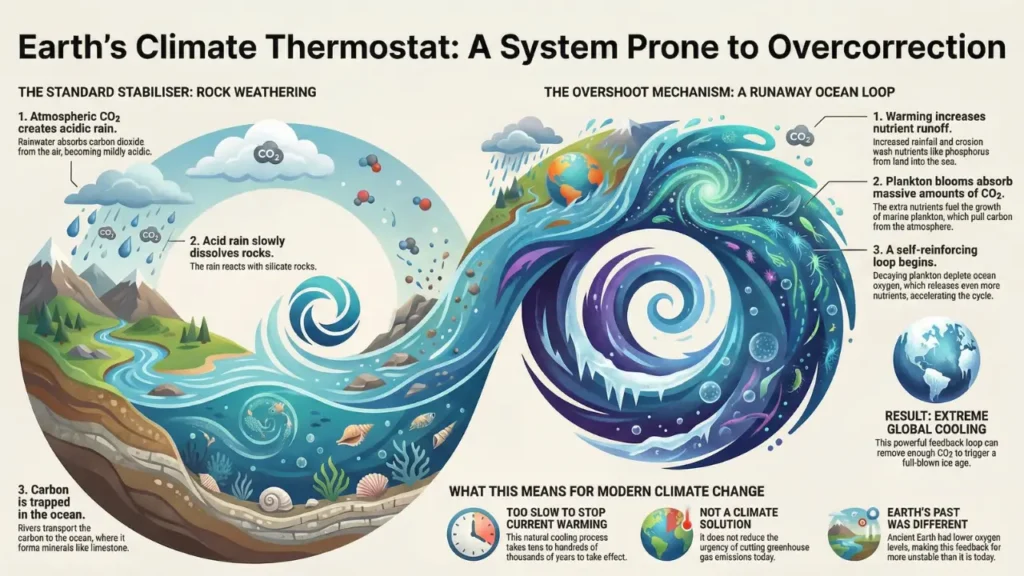
Modern climate change can activate ocean-driven carbon feedbacks that push the climate system beyond simple stabilization.
The researchers stress that this feedback operates over geological timescales, not decades or centuries. While modern climate change is warming the planet rapidly, any cooling response from this mechanism would take tens of thousands to hundreds of thousands of years to emerge.
Another important difference is oxygen. Earth’s ancient atmosphere had significantly lower oxygen levels, making this feedback far more unstable. Today’s higher oxygen concentrations reduce the likelihood of extreme runaway cooling.
In simple terms, modern climate change is pushing Earth’s thermostat, but not in a way that will cancel current warming within human lifetimes.
Insight, Not a Climate Solution
The importance of this research lies in understanding Earth’s deep climate history and improving long-term climate models. It shows that Earth’s climate system is not perfectly balanced, it can overcorrect under certain conditions.
However, this does not reduce the urgency of limiting greenhouse gas emissions today. The warming caused by modern climate change will continue to shape weather patterns, sea levels, and ecosystems long before any long-term cooling feedback could take effect.
Earth may eventually cool again, but not on a timeline that helps modern society.
Disclaimer: This article explains long-term climate science research. It does not suggest modern climate change will reverse soon or reduce the urgency of addressing current global warming impacts.


Contents
- 1 New research suggests modern climate change is testing Earth’s climate thermostat, revealing carbon cycle feedbacks that can overcorrect warming and drive long-term cooling across geological timescales.
- 2 A Climate Thermostat That Can Overshoot
- 3 How Earth Normally Regulates Its Climate
- 4 Why Ancient Ice Ages Were So Extreme
- 5 The Ocean’s Role in Carbon Removal
- 6 When Feedback Turns Into Overshoot
- 7 What This Means for Modern Climate Change
- 8 Insight, Not a Climate Solution