


Astronomers have detected the first confirmed CME from a Red Dwarf Star, revealing an eruption powerful enough to strip atmospheres from nearby planets. The discovery raises major concerns about habitability around red dwarfs—the most common stars in our galaxy.
A Historic Breakthrough in Stellar Space Weather
Astronomers have made a landmark discovery that reshapes our understanding of how violent a Red Dwarf Star can truly be. For the first time in history, researchers have directly detected a massive coronal mass ejection (CME) erupting from a star outside our solar system.
A finding that carries major consequences for the survival of planets orbiting these small but highly active stars. Using combined observations from the LOFAR radio telescope and the European Space Agency’s XMM-Newton space observatory, scientists traced an enormous CME back to a nearby Red Dwarf Star called STKM 1-1262, located about 130 light-years away.
The eruption was so extreme that it dwarfed anything the Sun has produced in recorded history. This breakthrough not only confirms the existence of stellar CMEs beyond our solar system but also raises serious concerns about the habitability of planets orbiting Red Dwarf Stars, the most common type of star in the Milky Way.
A Violent Eruption Thousands of Times Stronger Than the Sun’s
The detected CME was not a typical solar-style flare. Instead, it was a planet-threatening blast of superheated plasma traveling at almost 2,400 kilometers per second, a velocity observed in only 0.05% of solar eruptions.
For comparison:

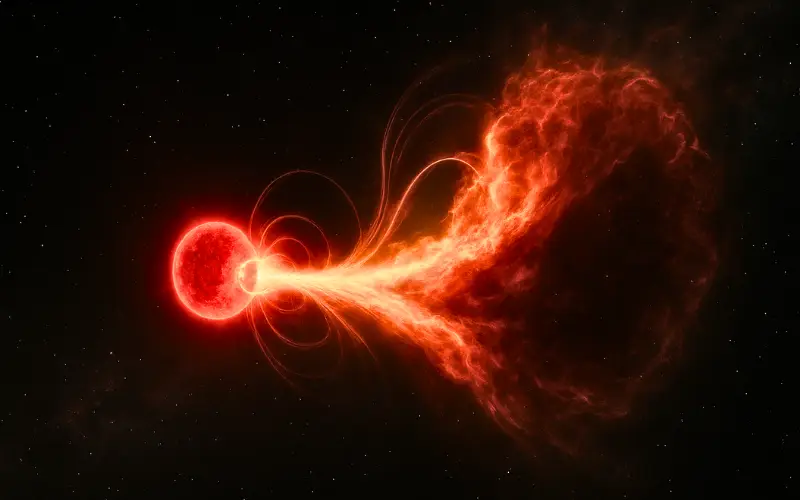
- The Sun’s CMEs average 400–800 km/s
- This Red Dwarf Star CME hit 2,400 km/s
- It carried enough force to strip atmospheres off nearby planets
According to astronomer Joe Callingham (ASTRON), this was the first time researchers could verify that plasma fully escaped a star’s magnetic field — confirming it as a true CME and not just a flare.
In simple terms:
A Red Dwarf Star can produce explosions so intense that any Earth-like planet nearby would be blasted bare.
Why Red Dwarf Stars Are a Bigger Threat to Planets
Despite their small size and cool temperatures, These Stars are far more magnetically active than the Sun. STKM 1-1262 — and many stars like it — possess:
- Magnetic fields up to 300× stronger
- Rotation speeds 20× faster
- Frequent flares and high-energy eruptions
- Unpredictable “superflares” that can be catastrophic
These powerful magnetic properties generate extreme space weather, with Dwarf Stars regularly launching CMEs capable of:
- Eroding planetary atmospheres
- Bombarding surfaces with radiation
- Disrupting climate stability
- Rendering habitats unlivable
This discovery confirms what scientists have theorized for years: planets around it may face hostile conditions incompatible with life as we know it.
Habitability Under Threat: Can Planets Survive it?
K2-18 b’s atmosphere raises exciting questions about life beyond Earth , but scientists urge caution.
Red Dwarf Stars are scientifically important because they host the majority of Earth-sized exoplanets found so far. Many lie within the “habitable zone” — the region where temperatures allow liquid water to exist.
But this new CME detection paints a far more dangerous picture.
Major habitability risks include:
- Atmospheric loss: CMEs can blow entire atmospheres into space.
- Radiation exposure: Without an atmosphere, radiation levels become lethal.
- Magnetic stripping: Repeated eruptions weaken protective magnetic fields.
- Climate collapse: Temperature regulation becomes impossible.
Even if a planet begins with Earth-like conditions, a hyperactive Red Dwarf Star can rapidly destroy its potential for life.
Henrik Eklund (European Space Research and Technology Centre) emphasizes that stellar activity around Red Dwarfs appears even more extreme than expected — reshaping scientific assumptions about survival zones around such stars.
First Confirmed Exoplanet CME: A Turning Point in Astronomy
For decades, astronomers suspected that stars beyond the Sun produced CMEs, but until now, direct evidence was lacking.
This historic detection was possible because:
- LOFAR captured the intense radio burst from the eruption.
- XMM-Newton confirmed the star’s magnetic and thermal conditions.
For the first time, scientists could match:
- The origin
- The radio signature
- The escaping plasma
- The star’s activity cycle
This gives researchers a new way to study stellar space weather, one of the least understood threats to exoplanet habitability.
What This Means for the Search for Life
Because Red Dwarf Stars are the most common stars in the galaxy, they host billions of planets — including many that appear to be Earth-like.
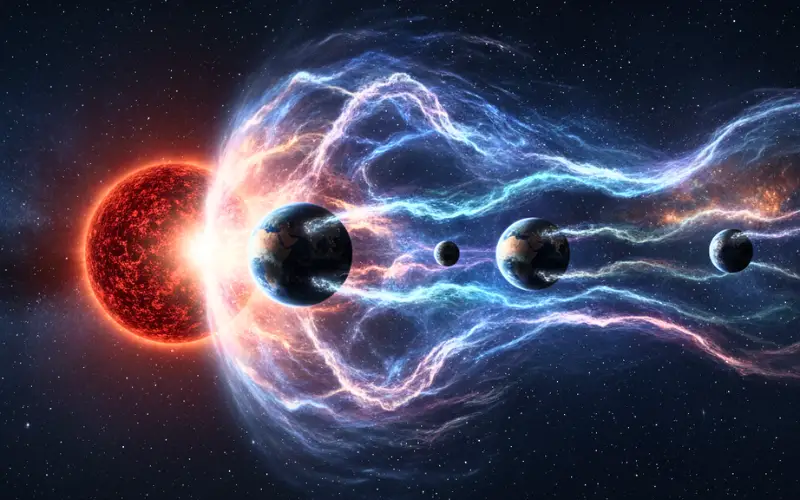
But this discovery challenges the optimism around them.
Key implications:
- Many “habitable zone” planets may be uninhabitable in reality
- Atmospheric erosion may be widespread
- Biosignatures could be erased before they form
- Habitability models must be rewritten
This detection is a warning that space weather may destroy planets long before life ever has a chance to develop.
The Future of Space Weather Research
Astronomers are now preparing for future missions that will push this research even further. The upcoming Square Kilometer Array (SKA), expected in the 2030s, will be powerful enough to detect CMEs from across the galaxy.
This will allow scientists to:
- Map stellar storms
- Identify dangerous stars
- Assess exoplanet survival
- Improve habitability predictions
The study of Red Dwarf Star space weather is entering a new era — and it may redefine the search for life itself.
Disclaimer: This article is based on current scientific observations and research. Findings may evolve with future data and should be interpreted within the context of ongoing studies.


Contents
- 1 A Historic Breakthrough in Stellar Space Weather
- 2 A Violent Eruption Thousands of Times Stronger Than the Sun’s
- 3 Why Red Dwarf Stars Are a Bigger Threat to Planets
- 4 Habitability Under Threat: Can Planets Survive it?
- 5 First Confirmed Exoplanet CME: A Turning Point in Astronomy
- 6 What This Means for the Search for Life
- 7 The Future of Space Weather Research