


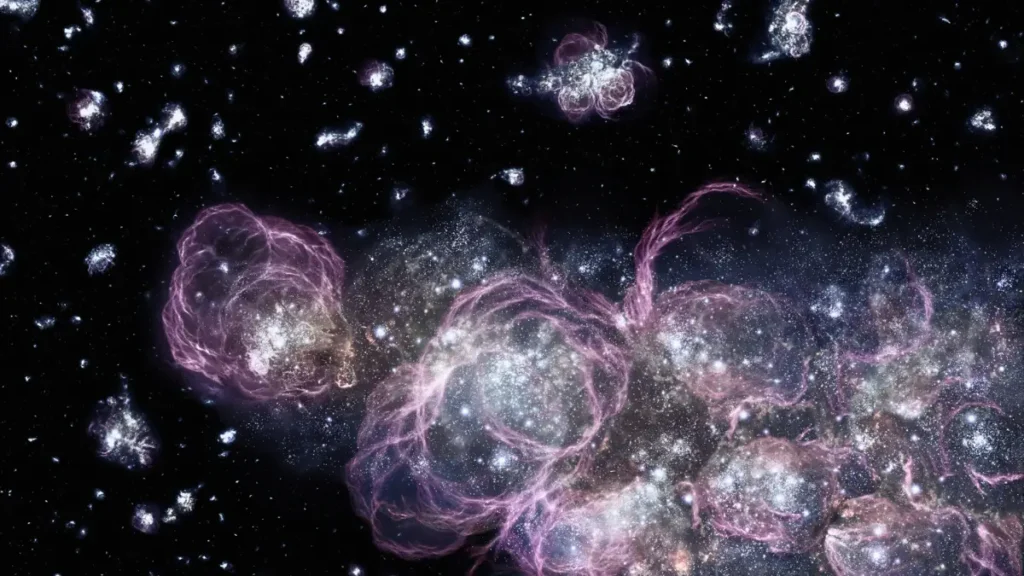
Cosmic elements began forming minutes after the Big Bang, evolved through stars and supernovae, and eventually shaped Earth, oceans, atmosphere, and human biology. This report traces their journey across 13.8 billion years.
WHY COSMIC ELEMENTS MATTER FOR UNDERSTANDING HUMAN ORIGINS
Every element inside your body, from the oxygen you breathe to the iron flowing through your blood, began its journey billions of years before Earth existed. Scientists call them cosmic elements, the fundamental building blocks of the universe.
Their story stretches across 13.8 billion years of cosmic evolution, weaving together the Big Bang, collapsing stars, supernova explosions, and the birth of life on our planet.
Today, as observatories and space telescopes capture unprecedented data, researchers are piecing together the most complete picture yet of how cosmic elements formed, spread, and eventually shaped human existence.
THE BIG BANG: THE FIRST CHEMICAL BLUEPRINT OF THE UNIVERSE
A tiny topological imbalance in spacetime might be the reason every galaxy, planet, and person exists today.
The universe began 13.8 billion years ago as a high-energy plasma, but new 2025 simulations from CERN and NASA reaffirm that within the first three minutes, only three stable cosmic elements could form:
- Hydrogen
- Helium
- Lithium (extremely small amounts)
This phase, called Big Bang Nucleosynthesis (BBN), set the ratio of elements that still determines the universe’s large-scale behavior today. Updated measurements from the South Pole Telescope (SPT-3G) in 2025 confirm that these primordial elements constitute the chemical “seed” from which all cosmic evolution emerged.
But heavier elements—carbon, nitrogen, silicon, iron—did not yet exist. Their creation required something far more complex: stars.
THE FIRST STARS: UNLOCKING THE UNIVERSE’S ELEMENT FACTORY
When gravity pulled primordial gas together, the first stars known as Population III stars are ignited. JWST data released in mid-2025 shows new evidence of ultra-massive early stars exceeding 200–300 times the mass of our Sun.
These giants lived fast and died violently, forging new elements via nuclear fusion:
- Hydrogen → Helium
- Helium → Carbon
- Carbon → Oxygen
- Oxygen → Neon, Magnesium, Silicon
- Silicon → Iron
This process of stellar nucleosynthesis is now mapped more precisely than ever. Recent spectroscopy from JWST’s NIRS pec instrument has identified carbon and oxygen signatures in galaxies only 300 million years after the Big Bang, pushing back the timeline for when heavy elements first appeared.
These first-generation stars essentially “switched on” the universe’s element cycle.
SUPERNOVAE AND NEUTRON STAR MERGERS: THE 2025 BREAKTHROUGH
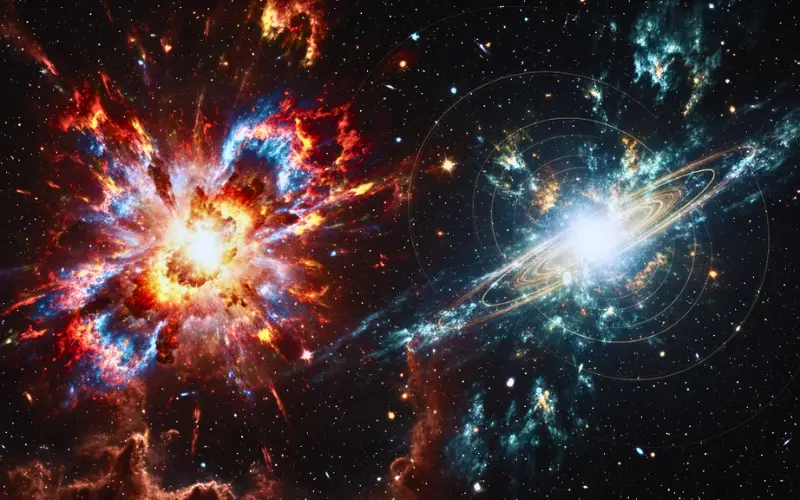
Modern research reveals that the most complex cosmic elements form in only two extreme environments:

1. Supernova Explosions
When massive stars run out of fuel, their collapse triggers temperatures billions of times hotter than the Sun’s core. Recent 2025 simulations from the Max Planck Institute indicate that nearly half of all elements heavier than iron like copper, strontium, and barium originate from these explosive events.
2. Neutron Star Mergers (R-Process Factories)
A major 2025 breakthrough came when LIGO-Virgo-KAGRA detected several neutron-star collision events with distinct heavy-element “fingerprints.” These mergers produced enormous amounts of:
- Gold
- Platinum
- Uranium
- Rare-earth metals
Element signatures observed in the kilonova afterglow confirm that neutron-star mergers are the primary factories for the universe’s heaviest cosmic elements.
Scientists now believe that the gold in human jewelry and the iodine in our bodies were forged in cosmic catastrophes billions of years before the solar system formed.
HOW COSMIC ELEMENTS BUILT EARTH AND THE SOLAR SYSTEM
About 4.6 billion years ago, a cloud enriched by earlier supernovae collapsed to form the Sun. Surrounding dust and gas coalesced into planets.
New 2025 isotopic studies reveal:
- Earth’s iron core contains material from multiple supernova explosions.
- The water on Earth came partly from icy cosmic dust grains containing hydrogen and oxygen.
- Silicon, magnesium, and aluminum in Earth’s crust trace back to second-generation stars.
COSMIC ELEMENTS AND THE EMERGENCE OF LIFE
Life on Earth depends on six essential elements are Carbon, Hydrogen, Nitrogen, Oxygen, Phosphorus, Sulfur (CHNOPS). All six originated in stars.
But new 2025 studies offer deeper insights:
- Carbon-based molecules have now been detected in exoplanet atmospheres more often than previously believed.
- JWST discovered organic precursors are complex carbon chains inside distant star-forming nebulae.
- Experiments suggest that phosphorus, once considered rare, is more abundant in supernova debris than earlier models predicted.
This strengthens the hypothesis that life’s chemical foundations were seeded by ancient cosmic processes long before Earth existed.
HOW SCIENTISTS STUDY COSMIC ELEMENTS TODAY
- Galactic Metallicity Mapping
Astronomers use metallicity maps to study how rich or poor different regions of galaxies are in heavy cosmic elements. In 2025, these maps have become 20× more detailed due to AI-enhanced spectroscopy. - Exoplanet Atmosphere Scanning
Using JWST and ground-based telescopes, scientists are detecting atomic signatures are sodium, potassium, oxygen on planets hundreds of light-years away. - Cosmic-Ray Chemistry & Earth’s Climate
A 2025 study from the University of Helsinki suggests cosmic rays may influence cloud microphysics, although this remains under investigation.
CONCLUSION
The journey of cosmic elements is not just a story of physics—it’s our origin story. Every atom inside the human body was produced in distant stars, scattered across space, reassembled into Earth, and ultimately shaped into life.
Disclaimer: This article summarizes ongoing scientific research. Findings are subject to revision as new data emerges. Visuals are illustrative. Readers should consult original studies for formal scientific conclusions


Contents
- 1 Cosmic elements began forming minutes after the Big Bang, evolved through stars and supernovae, and eventually shaped Earth, oceans, atmosphere, and human biology. This report traces their journey across 13.8 billion years.
- 2 WHY COSMIC ELEMENTS MATTER FOR UNDERSTANDING HUMAN ORIGINS
- 3 THE BIG BANG: THE FIRST CHEMICAL BLUEPRINT OF THE UNIVERSE
- 4 THE FIRST STARS: UNLOCKING THE UNIVERSE’S ELEMENT FACTORY
- 5 SUPERNOVAE AND NEUTRON STAR MERGERS: THE 2025 BREAKTHROUGH
- 6 1. Supernova Explosions
- 7 2. Neutron Star Mergers (R-Process Factories)
- 8 HOW COSMIC ELEMENTS BUILT EARTH AND THE SOLAR SYSTEM
- 9 COSMIC ELEMENTS AND THE EMERGENCE OF LIFE
- 10 HOW SCIENTISTS STUDY COSMIC ELEMENTS TODAY
- 11 CONCLUSION