

For decades, scientists have looked at Mars and wondered: Did life ever exist there?
Now, NASA’s Perseverance rover may have taken us closer than ever to answering that question.
In what NASA calls a “groundbreaking discovery,” the rover has detected unusual mineral and organic patterns in rocks inside Jezero Crater—signals so compelling that researchers are re-evaluating how we define life on mars beyond Earth.
Unearthing Ancient Secrets Beneath Martian Soil
In July 2024, Perseverance drilled into an ancient riverbed system named Bright Angel and extracted a rock core called Cheyava Falls.
At first glance, it looked like just another reddish stone scattered across the crater floor.
But deep analysis revealed something extraordinary—minerals and organic carbon arranged exactly like microbial signatures found in Earth’s oldest sediments.
According to the peer-reviewed Nature study, the findings don’t yet confirm life, but they qualify as “potential biosignatures.”
That term, under NASA’s Confidence of Life Detection (CoLD) framework, means the evidence is strong enough to warrant serious biological investigation.
The “Leopard-Spotted” Rocks That Sparked Hope
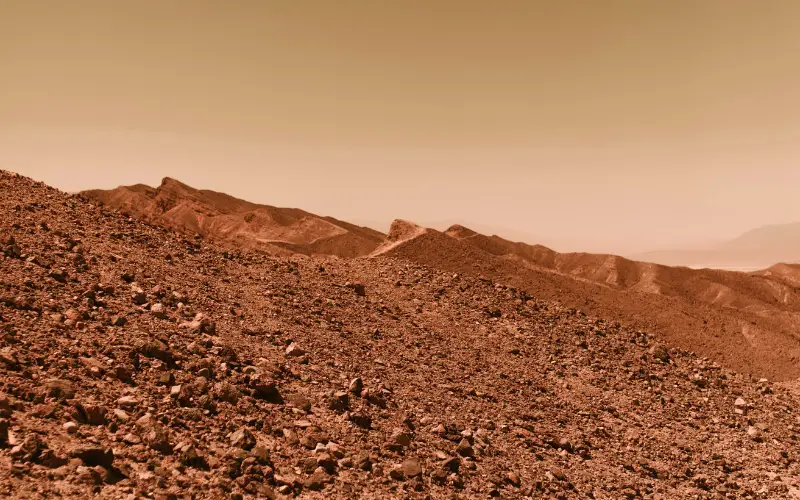
Images sent by Perseverance show a striking pattern on the Cheyava Falls rock—leopard-like spots that caught scientists’ attention immediately.
Within these spots, two rare minerals—vivianite (iron phosphate) and greigite (iron sulfide)—appear side by side in perfect chemical balance.
On Earth, these minerals often form when microbes metabolize iron in oxygen-poor water environments.
Even more intriguing, vivianite rims were seen surrounding greigite cores, creating a bullseye-like texture identical to those seen in microbial mats and lake sediments on Earth.
“It’s one of the clearest potential signs of biological activity we’ve ever observed on life on Mars,” said Sean Duffy, NASA’s acting administrator.
Still, both Duffy and lead researcher Joel Hurowitz of Stony Brook University urge caution—saying further tests are needed before drawing conclusions about life.
Organic Matter Found Across Multiple Sites
Beyond minerals, NASA’s instruments also detected organic carbon molecules—a building block of life—within the same formations.
Using the SHERLOC and PIXL instruments on the rover’s robotic arm, scientists mapped these organic compounds in three distinct regions:
- Cheyava Falls
- Walhalla Glades
- Apollo Temple
The strongest organic signal appeared at Apollo Temple, where both vivianite and greigite were most concentrated.
However, another nearby site, Malgosa Crest, showed neither mineral nor organic presence—suggesting the chemical pattern isn’t random but rather localized to environments that may once supported life.
Even so, researchers warn that organic molecules can also form abiotically—through chemical reactions without life or via meteorite delivery.
That’s why NASA is treating life on mars as a “possible” biosignature, not proof.
How Artificial Intelligence Helped To Find Life On Mars
One of the unsung heroes of this discovery isn’t human—it’s AI.
NASA’s PIXL (Planetary Instrument for X-ray Lithochemistry) uses adaptive sampling software that lets the rover autonomously identify minerals with unusual chemistry.
“When PIXL detects something strange, it pauses and zooms in automatically,” said Dr. Abigail Allwood, PIXL’s principal investigator at the Jet Propulsion Laboratory (JPL).
“This AI guidance helps us focus our analysis on the most promising areas—without waiting hours for commands from Earth.”
Meanwhile, SHERLOC (Scanning Habitable Environments with Raman & Luminescence for Organics and Chemicals) scans rock textures at the microscopic level using ultraviolet lasers.
Together, these tools have allowed Perseverance to act as a self-guided geochemist on another planet, collecting data faster and more precisely than any rover before it.
The Mars Sample Return Mission
The rock core collected in July 2024 remains sealed inside a titanium tube on Mars’s surface.
It’s waiting for a future mission—the NASA-ESA Mars Sample Return campaign—to bring it home.
Once the sample reaches Earth, scientists will perform isotopic and molecular analysis with high-precision instruments unavailable on Mars.
Only then will we know whether the detected carbon patterns and mineral structures truly represent ancient microbial life or non-biological chemistry shaped by time and water.
Even if the answer is the latter, this discovery still paints a vivid picture of a once-water-rich, chemically active Mars—a world that may have been habitable billions of years ago.
Why This Matters
If later confirmed as biological, this would mark the first direct evidence of extraterrestrial life—a discovery on par with Galileo’s first glimpse of Jupiter’s moons or the Apollo landings.
But even short of that, it revolutionizes our understanding of Mars as a dynamic planet with a complex geochemical past.
“This is how science progresses—carefully, step by step,” said Hurowitz.
“Each new signal brings us closer to answering the oldest question: Are we alone in the universe?”
A New Era for Planetary Exploration

Final Thought
The quest for life on Mars is no longer a far-off dream—it’s a measurable, data-driven pursuit grounded in evidence.
Whether or not microbes ever thrived there, NASA’s latest findings remind us of something deeper:
The universe is far more alive, complex, and interconnected than we once imagined.
Disclaimer: This article is based on current research and data from credible space agencies like NASA and ESA. Information about life on Mars may change as new studies emerge. The content is intended for informational and educational purposes only.

Contents