


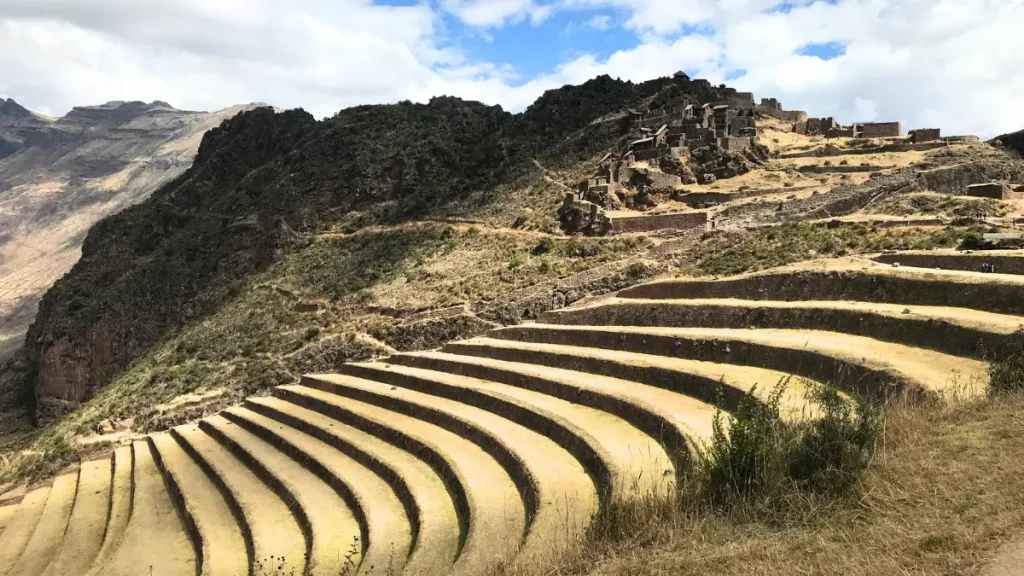
Archaeologists have uncovered the true purpose behind Peru’s 5,200 mysterious holes near Pisco Valley. New research confirms the Code of Peru was an ancient Inca system used for record-keeping, storage, and resource management centuries before written documentation.
Unraveling the Ancient Code of Peru
Hidden deep within the dry mountains of Pisco Valley, Peru, lies one of the world’s most puzzling archaeological wonders — a site known as the “Band of Holes”(as per reports of Wikipedia). For decades, thousands of mysterious pits carved into the rocky slope left researchers confused and locals awestruck.
Now, after years of analysis, archaeologists believe they have finally cracked what they call the “Code of Peru.” These 5,200 man-made holes were not random creations or cosmic messages – they formed an ancient data system that reflected the organization, intelligence, and power of the Inca civilization.
The Code of Peru tells a story not written in ink but etched into the earth – a message from a society that thrived long before modern record-keeping existed.
The Discovery That Sparked Curiosity
The strange site was first captured in aerial photographs during the 1930s, when explorers flying over the Nazca and Pisco Valleys noticed rows upon rows of uniform holes stretching for nearly 1.5 kilometers.
Each hole measured roughly one meter wide and two meters deep, perfectly aligned in rows running north to south. From the air, the formation looked like a massive barcode or snake — which later inspired the name “Monte Sierpe”, meaning Mountain of the Serpent.
For years, no one could decode what these holes represented. Some called them burial chambers, others storage units, and a few even linked them to extraterrestrial theories similar to the nearby Nazca Lines. But the truth behind the Code of Peru was far more grounded and far more brilliant.
Decoding the Code of Peru: A New Archaeological Breakthrough

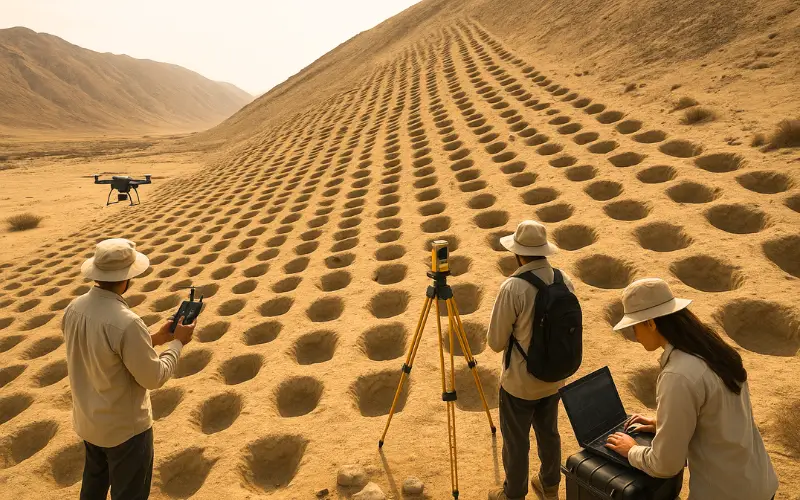
Recent drone-based mapping, 3D terrain modeling, and soil analysis have given archaeologists a fresh look at the 5,200 holes that make up the Code of Peru.
Experts from Peruvian universities and international research teams have concluded that the holes were part of a sophisticated administrative or inventory system, used during the Inca or pre-Inca era (around 500–1500 CE).
Their layout and pattern strongly resemble counting grids or resource-allocation systems, which the Incas used to manage their vast empire that stretched across western South America.
The Inca civilization was known for its centralized economy and precision management, even without a written language. They relied on quipus-knotted cords that recorded numbers and data-and vast networks of storehouses (qullqas) for grains and food supplies.
Archaeologists now believe that the Band of Holes acted as a physical counting or measuring station, where officials recorded or stored food, crops, or goods. Each pit may have symbolized a unit, count, or storage segment, forming a large-scale open-air ledger-the literal Code of Peru.
What the Code of Peru Reveals About Ancient Intelligence?
The ancient Code of Peru is no longer a mystery — it’s proof of the Incas’ unmatched precision and organization.
The Code of Peru isn’t just a mystery solved-it’s a revelation of how advanced ancient Andean societies were.
While the world often marvels at the Egyptian pyramids or Roman aqueducts, the Incas built a system of control and record-keeping that was invisible until now.
Through structures like the Band of Holes, they managed trade, agriculture, and population data across mountainous terrain-all without paper, writing, or machines.
The fact that these 5,200 holes are so uniformly shaped and aligned indicates organized labor and centralized planning-traits that define the administrative genius of the Inca Empire.
This makes the Code of Peru one of the earliest examples of data visualization and resource tracking in human history.
Cultural and Historical Significance of the Code of Peru
The discovery of the Code of Peru reshapes our understanding of pre-Columbian civilizations.
It demonstrates that knowledge and organization were not exclusive to literate societies. The Inca Empire, despite lacking a written alphabet, built a management system that rivaled modern logistics.
For Peruvians, this discovery strengthens their national heritage -linking today’s people to a civilization that mastered both the mountains and mathematics.
Internationally, it places the Code of Peru alongside other global archaeological wonders, reminding the world that intelligence takes many forms-not just written words, but also patterns carved into the earth.
Preserving the Code of Peru for Future Generations
The Peruvian government and the Ministry of Culture are now working to protect the Band of Holes from erosion and vandalism.
Tourists can visit the site with guided tours, viewing the Code of Peru from nearby hills or via drone footage.
Archaeologists are also using digital scanning and virtual reconstruction to document the structure for future study.
These initiatives ensure that this ancient code-written not in text but in terrain-remains preserved for generations to come.
Conclusion:
The Code of Peru is more than an archaeological discovery-it’s a story of innovation, intelligence, and communication beyond words. The 5,200 holes stand as a testament to how the Inca civilization managed complexity with creativity.
After centuries of mystery, archaeologists have finally decoded the language of the earth itself.
The Band of Holes shows that humanity’s thirst for order and understanding transcends time-and that even the most silent monuments can speak volumes when we learn to listen.
Disclaimer:
Information in this post is based on publicly available research and verified archaeological findings. Interpretations of the Code of Peru may evolve as new evidence emerges from ongoing scientific studies.


Contents
- 1 Archaeologists have uncovered the true purpose behind Peru’s 5,200 mysterious holes near Pisco Valley. New research confirms the Code of Peru was an ancient Inca system used for record-keeping, storage, and resource management centuries before written documentation.
- 2 Unraveling the Ancient Code of Peru
- 3 The Discovery That Sparked Curiosity
- 4 Decoding the Code of Peru: A New Archaeological Breakthrough
- 5 What the Code of Peru Reveals About Ancient Intelligence?
- 6 Cultural and Historical Significance of the Code of Peru
- 7 Preserving the Code of Peru for Future Generations
- 8 Conclusion:
- 9 Disclaimer: