


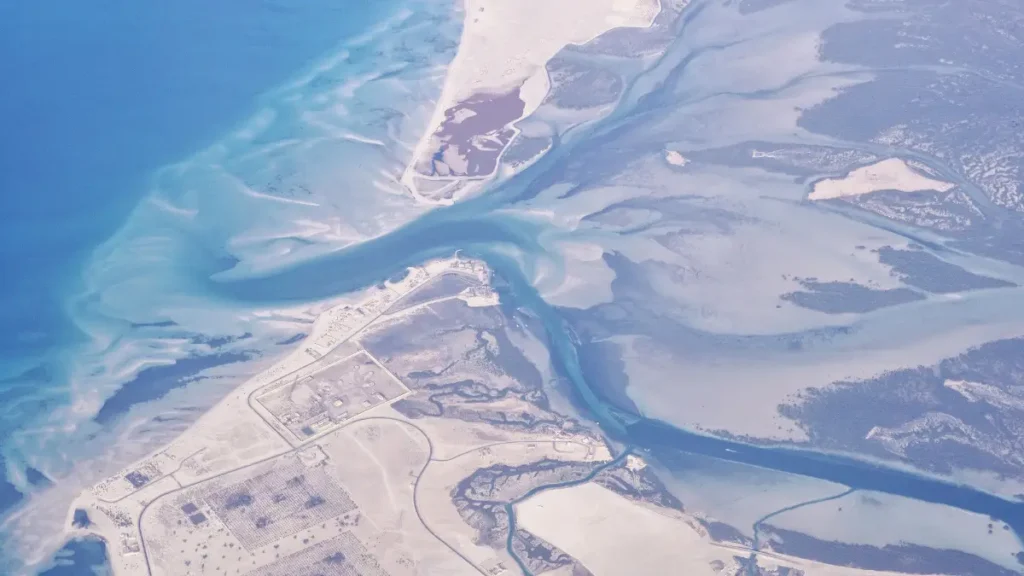
A new study reveals the Gulf of Suez Rift is still widening, contradicting decades of scientific belief. Subtle tectonic movement, uplifted coral reefs, and micro-earthquakes show the rift remains active, reshaping how geologists understand so-called “failed” rift systems.
Rift Thought to Be Dormant Shows Signs of Life
The Gulf of Suez Rift began forming around 28 million years ago, when the Arabian Plate started drifting away from Africa. For years, scientists believed the rifting process ceased around 5 million years ago, leaving behind a tectonic zone that was essentially frozen in time.
However, new high-resolution mapping and seismic analyses show that the rift is:
- Still widening, at about 0.02 inches (0.5 cm) per year
- Experiencing subtle fault shifts
- Displaying vertical uplift of ancient coral structures
- Recording ongoing micro-earthquake activity
These findings confirm that the Gulf of Suez Rift remains tectonically active, though at a pace far slower than typical ocean-forming rifts like the Red Sea.
Lead researcher David Fernández-Blanco of the Chinese Academy of Sciences said the discovery “fundamentally changes how we think about rift evolution.”
“Rifts have always been described as successful or failed,” Fernández-Blanco explained.
“Our research shows many rifts neither fully succeed nor fully fail — they simply slow down but continue evolving.”
Satellite and Geological Data Reveal Hidden Movement
Using modern tools such as detailed elevation models, fault-mapping techniques, and satellite-based measurements, scientists detected several indicators of ongoing tectonic deformation.
Key scientific observations include:
- Widening continues at 0.5 cm per year — a measurable but slow tectonic drift.
- Ancient coral reefs that formed at prehistoric sea levels now sit 60 feet (18.5 meters) above present sea level.
- Small but persistent earthquakes indicate active crustal stress.
- Reactivated intra-rift faults show new displacement patterns previously unnoticed.
Researchers say these combined signals rule out any possibility that the region is tectonically dormant.
A Third Category of Rift Evolution

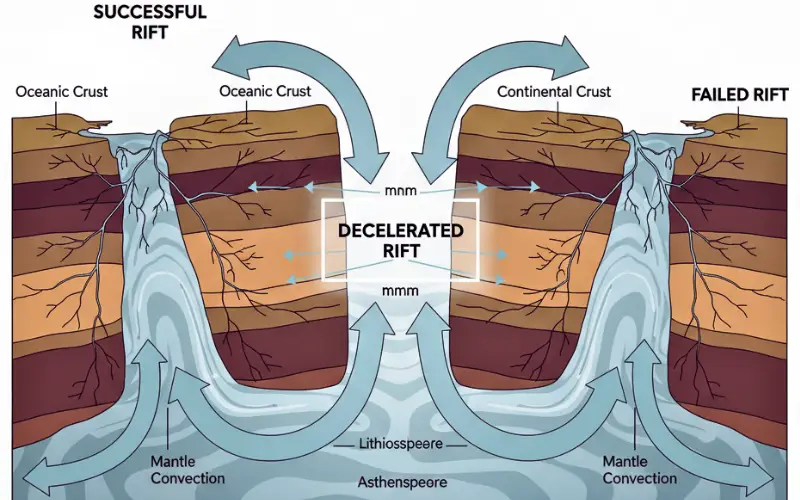
Traditionally, geologists classified rifts into two outcomes:
- Successful rifts, which evolve into new oceans (e.g., the Red Sea)
- Failed rifts, which shut down completely and remain inactive
The Gulf of Suez was long believed to belong to the second category.
However, the new study introduces a third model:
Decelerated rifts
The Arabian and African plates didn’t split 28 million years ago — but the Gulf of Suez never stopped trying. The rift is still alive.
In this middle stage, rifts continue to stretch at millimeter-level rates, maintaining tectonic relevance despite lacking dramatic surface features.
Fernández-Blanco emphasized that the forces driving rifting are more complex than simple plate motion.
“Changing plate boundary conditions don’t necessarily shut down rifting,” he said.
“The processes are persistent and respond to a variety of deep Earth mechanisms.”
Evidence of Gulf of Suez From Coral Reefs and Earthquakes
One of the strongest indicators of ongoing tectonic uplift came from raised coral reef terraces along the Suez coastline. These formations, which once grew at sea level, now sit far above the waterline, suggesting long-term crustal elevation.
Additionally, seismic monitoring has detected:
- Frequent micro-earthquakes
- Subtle fault-line adjustments
- Minor crustal deformation
While none point to immediate seismic danger, they collectively support the conclusion that the region remains geologically active.
Implications for Other “Failed” Rifts Worldwide
The study’s findings extend beyond the Gulf of Suez. Scientists believe many other rifts previously labeled as “failed” may still retain low-level tectonic activity.
Regions that may require re-evaluation include:
- The Dead Sea fault system
- Ancient rifts in East Africa
- Western U.S. rift provinces
- Dormant Eurasian rift zones
These areas could carry greater seismic or geological significance than previously assumed.
Conclusion
The new findings from the Gulf of Suez challenge long-standing assumptions about how continents break apart. Instead of shutting down millions of years ago, the rift continues to widen at millimeter-scale rates, revealing a subtle but persistent tectonic force at work.
This “decelerated rift” model suggests Earth’s crust is far more dynamic and unpredictable than previously believed. As technology advances, scientists expect more hidden tectonic activity to emerge — redefining our understanding of so-called “failed” rifts worldwide.
Disclaimer:
This article provides an educational summary of current geoscientific research. For authoritative interpretations or hazard assessments, consult accredited geological institutions and official datasets.

