


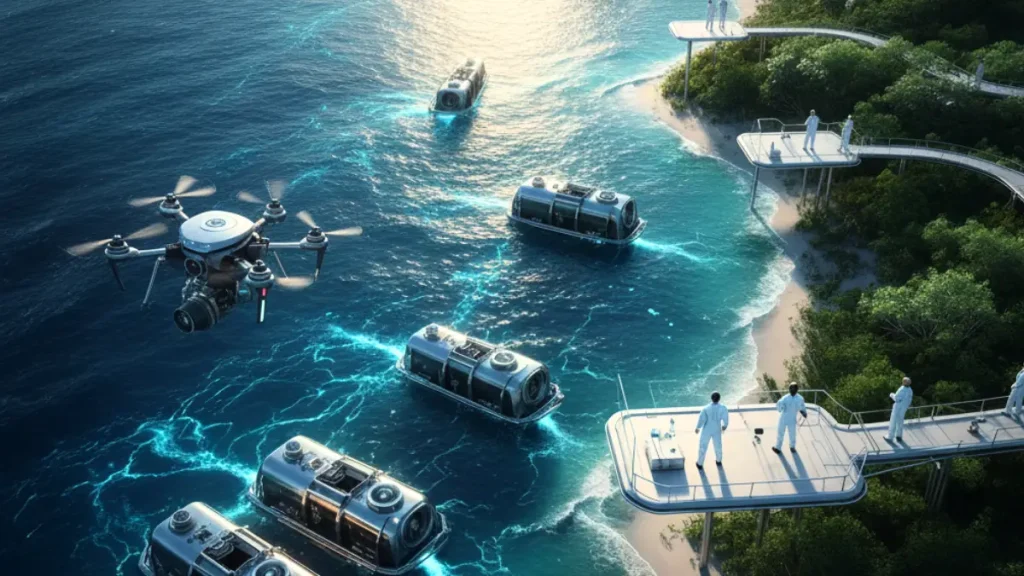
When we think about fighting climate change, forests and renewable energy dominate the conversation. But there’s another powerful ally that often goes unnoticed — the ocean. Covering more than 70% of Earth’s surface, it silently absorbs around 25% of human-made CO₂ emissions every year.
In the United States, scientists, innovators, and policymakers are turning their eyes seaward. This growing movement — the Blue Carbon Revolution — aims to use marine ecosystems and ocean-based technologies to capture, store, and manage carbon at massive scales.
From restoring coastal mangroves to pioneering direct ocean capture systems, the U.S. is positioning its 95,000 miles of coastline as a strategic carbon asset in the global push toward net-zero by 2050.
What the Blue Carbon Revolution Means
At its core, the Blue Carbon Revolution combines natural climate solutions with advanced marine engineering to remove carbon from the atmosphere and store it in oceanic systems. It’s not a single technology but an integrated climate framework that spans ecology, chemistry, and innovation.
Blue-Carbon Ecosystems
Coastal wetlands such as mangroves, salt marshes, and seagrass meadows act as some of Earth’s most efficient carbon sinks — sequestering carbon up to 10 times faster than terrestrial forests. In the U.S., these ecosystems stretch across the Gulf of Mexico, Florida Keys, and Pacific Northwest, quietly storing carbon for centuries beneath layers of sediment.
Ocean Alkalinity Enhancement
Scientists are experimenting with adding alkaline minerals like olivine or basalt dust to seawater. These substances increase ocean pH levels, enabling it to absorb more CO₂ naturally. It’s a scalable solution that could help counter ocean acidification while capturing billions of tons of carbon.
Direct Ocean Capture (DOC)
American startups are developing electrochemical systems that pull dissolved carbon dioxide directly from seawater. Unlike traditional CCS, DOC systems can operate using renewable energy, making them ideal for integration with offshore wind farms.
Sub-Seabed Carbon Storage
The Gulf of Mexico’s deep geological formations offer stable reservoirs for permanent CO₂ storage. Similar to underground carbon storage on land, this method uses advanced drilling and monitoring technology to lock carbon beneath impermeable rock layers — safely isolating it for thousands of years.
Policy Momentum Behind the Revolution

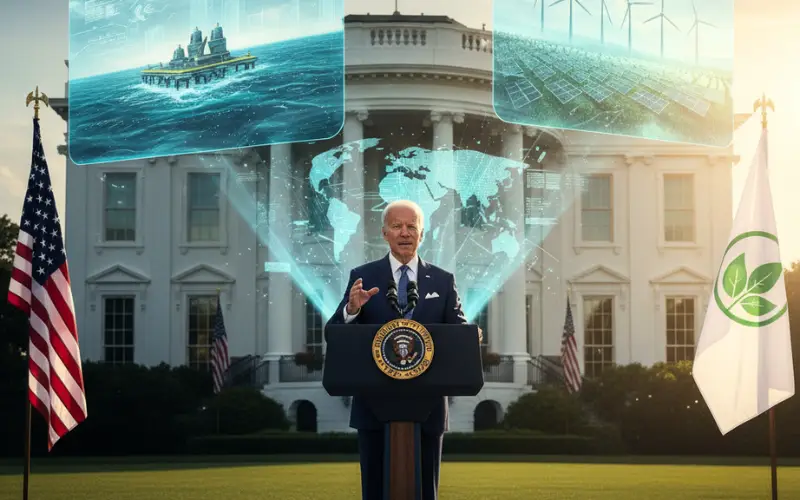
For decades, ocean-based carbon strategies were seen as futuristic. That perception is changing fast. The Biden Administration and several state governments are expanding the climate agenda from land to sea.
- Department of Energy’s CarbonSAFE Offshore Program is identifying undersea geological formations suitable for large-scale CO₂ storage.
Early assessments in the Gulf of Mexico suggest capacity to store billions of tons of emissions. - NOAA’s Blue Carbon Initiative now officially quantifies how U.S. wetlands, estuaries, and tidal ecosystems contribute to the national carbon budget.
- The Inflation Reduction Act (IRA) introduced robust tax incentives for carbon-capture infrastructure — a financial backbone that encourages private investment in offshore sequestration.
- States such as California, Maine, and Louisiana are crafting Blue Carbon Action Plans linking coastal protection, carbon markets, and economic growth.
Innovation and Research — The Engine of Progress
Behind the policy push lies a vibrant ecosystem of scientists, startups, and research institutions driving real-world innovation.
- Woods Hole Oceanographic Institution and Ocean Visions are leading U.S. efforts to design AI-based monitoring systems that can verify carbon sequestration under the sea with unprecedented precision.
- California-based Capture6 has developed an electrochemical process that extracts CO₂ from seawater while generating fresh water as a by-product — a dual-benefit system with potential applications in drought-prone regions.
- Project Vesta, operating along the Atlantic Coast, is testing natural mineral weathering by adding crushed olivine sand to beaches. The sand reacts with seawater, locking carbon into solid bicarbonates while stabilizing shorelines.
- The Pacific Northwest National Laboratory (PNNL) is exploring bio-engineered kelp farms as carbon sponges that could feed into future blue-carbon credit systems.
The Challenges of Scaling the Blue Carbon Revolution
Despite remarkable momentum, scaling blue-carbon initiatives nationwide comes with serious challenges.
- Monitoring and Verification (MRV): Tracking carbon underwater is vastly more complex than on land. Without consistent MRV frameworks, it’s difficult to issue verified carbon credits or prove long-term storage stability.
- Environmental Safeguards: Any large-scale modification of ocean chemistry carries potential ecological risks. Policymakers must balance carbon capture goals with biodiversity protection.
- Legal and Regulatory Frameworks: Offshore carbon storage blurs the jurisdictional lines between the EPA, NOAA, and the Department of the Interior. The U.S. will need unified laws to govern ownership, liability, and monitoring rights for subsea storage.
- Public Trust and Awareness: For coastal communities, transparency is key. Engaging local fishermen, Indigenous populations, and tourism industries ensures that blue-carbon projects generate both environmental and social value.
Blueprint for America’s Blue Carbon Future
Experts propose a five-pillar national roadmap to make blue carbon central to the U.S. climate strategy:
- Unified Policy Framework – Establish a single national coordination body linking the EPA, NOAA, and DOE to synchronize blue-carbon goals.
- Public–Private Collaboration – Incentivize startups and corporations through grants, tax credits, and data-sharing platforms.
- Financial Innovation – Launch Blue Bonds and verified carbon-credit systems to fund restoration projects and technological research.
- Data Transparency & Open Science – Mandate open access to monitoring data for global peer review and accountability.
- International Partnerships – Work with nations like Norway, Japan, and Australia to harmonize standards for oceanic carbon sequestration.
If executed effectively, this blueprint could transform America’s coastlines into living carbon infrastructures — not just protecting biodiversity but also driving green jobs, research, and climate resilience.
Turning the Tide on Carbon
The Blue Carbon Revolution represents a paradigm shift in how the United States confronts climate change. It moves beyond the traditional land-based model and embraces the ocean as a solution, not just a casualty.
By combining sound science, smart regulation, and bold innovation, America can lead the world in turning its oceans into powerful carbon allies. The nation’s coastlines — from the Gulf of Mexico to the Pacific — hold not just scenic beauty, but the blueprint for a sustainable future.
Disclaimer: This article is created for educational and informational purposes only. It is based on publicly available research and climate data, not on official government statements or endorsements.