
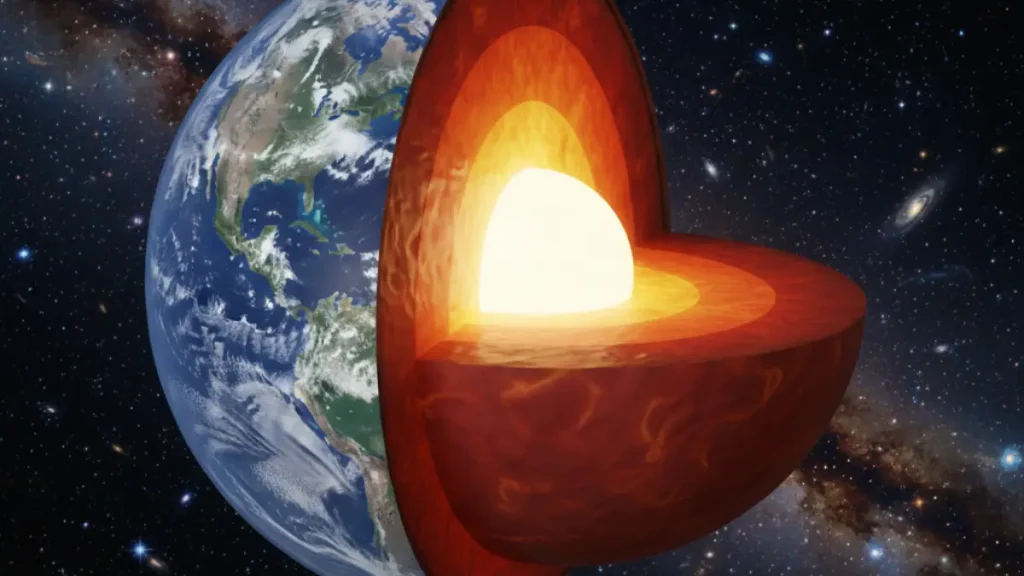
Earth may be billions of years old — but what if parts of it are even older than we imagined.
In 2025, a team of geologists revealed stunning evidence that fragments from Earth’s earliest version — the “proto-Earth” — still exist deep beneath our planet’s surface.
Published in Nature Geoscience, the study suggests that massive rock structures hidden in Earth’s mantle are actually relics from the violent collision that birthed both Earth and the Moon — a discovery that could rewrite everything we know about our planet’s beginnings.
“It’s like discovering fossils of a planet that existed before Earth itself,” said Dr. Qian Yuan, planetary scientist at Caltech.
How Scientists Peered Into Earth’s Ancient Core
The discovery was made possible through 3D seismic tomography, a powerful imaging technique that uses earthquake-generated seismic waves to map structures deep below the surface.
This revealed two giant, unusual zones — known as Large Low Shear Velocity Provinces (LLSVPs) — located beneath Africa and the Pacific Ocean.
Unlike typical mantle material, these regions were denser, hotter, and chemically distinct, hinting that they could be leftover fragments from the proto-Earth, preserved since the planet’s fiery birth 4.5 billion years ago.
When Earth Was Born Twice
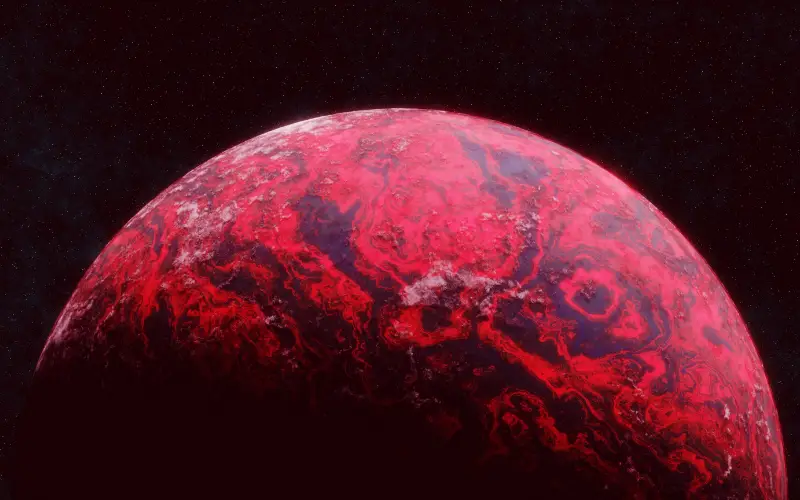
Around 4.5 billion years ago, a Mars-sized planet named Theia is believed to have slammed into the early Earth — a catastrophic event that melted both worlds.
The collision ejected enormous amounts of debris into orbit, which later condensed into the Moon.
But this study suggests that the story didn’t end there — some of Theia’s material, and parts of Earth’s original crust, may have sunk into the deep mantle, where they survived undisturbed for billions of years.
“These fragments are geological time capsules,” said Professor Hrvoje Tkalčić from the Australian National University.
“They tell us that the proto-Earth still exists, hidden deep within today’s Earth.”
Where Are the Proto-Earth Remnants Found?
Researchers pinpointed two specific regions that might contain the oldest materials on the planet:
- Under West Africa — near the core-mantle boundary.
- Beneath the Pacific Ocean Basin — extending thousands of kilometers wide.
These regions have long puzzled geologists.
They’re responsible for powerful volcanic hotspots, such as Hawaii and Iceland, and appear to act as heat reservoirs regulating Earth’s internal processes.
How This Discovery Changes Earth Science
This isn’t just a geology story — it’s a planetary evolution breakthrough.
Until now, scientists believed that the Moon-forming collision completely erased early Earth’s crust.
But the new evidence shows that fragments of proto-Earth and Theia fused and sank, forming part of Earth’s deep interior.
This revelation could help explain:
- Why the mantle has different compositions in different parts of the world.
- How heat and elements like iron and silicon are distributed unevenly.
- Why volcanic activity varies across continents.
Essentially, it proves that Earth remembers its own creation — its geological DNA still contains traces of the planet it once was.
The Planet That Never Died: Earth’s Memory in Motion
These ancient remnants have likely influenced Earth’s evolution for billions of years — driving plate tectonics, volcanic hotspots, and even the magnetic field.
Their survival also challenges previous assumptions about planetary collisions — suggesting that not everything is lost during such impacts.
Dr. Yuan explains:
“We used to think that giant impacts reset a planet’s chemistry completely. But these structures show survival is possible — even in the most extreme conditions.”
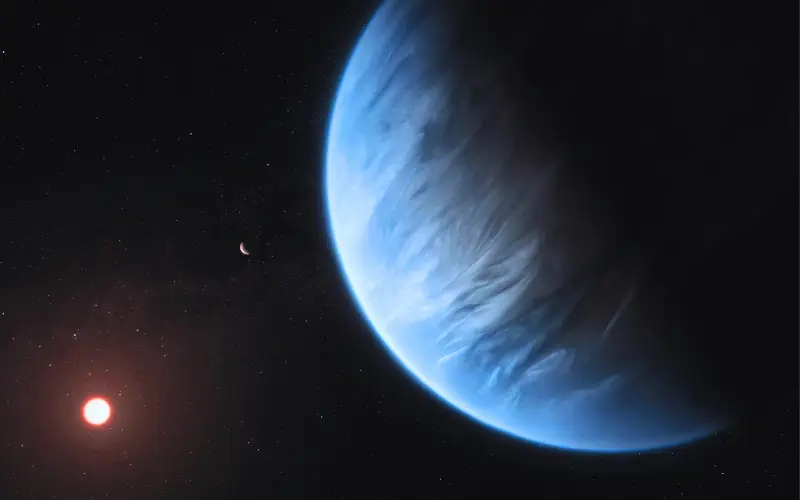
This discovery also reshapes how we understand exoplanets — rocky worlds orbiting distant stars.
If proto-materials can survive catastrophic impacts on Earth, the same may be true for planets beyond our solar system.
Why It Matters for the Future of Science
Understanding these ancient mantle structures can help scientists:
- Predict volcanic activity by mapping heat anomalies.
- Refine models of planetary formation across the universe.
- Reassess climate evolution, since deep mantle processes influence long-term CO₂ cycling.
A Cosmic Perspective — Lessons from Our Origins
The discovery highlights one crucial truth: Earth is not just a planet; it’s a survivor.
While other rocky worlds like Mars and Mercury bear scars of their formation, Earth may be the only one still carrying fragments of its earliest existence within.
These deep relics connect us — not only to our planet’s geological history but to the solar system’s creation story itself.
Beneath the Surface Lies Earth’s Ancient Soul
This discovery reminds us that the past never truly disappears.
Hidden thousands of kilometers below, the proto-Earth’s ancient remains still shape our planet’s heartbeat — influencing volcanoes, magnetic fields, and even the continents above.
It’s as if Earth carries a memory of its own birth, echoing through the mantle like a story written in stone.
And every earthquake, eruption, and seismic wave is a whisper from that distant time when our planet was still becoming itself.
Disclaimer: This report is crafted to inform and inspire curiosity about Earth’s scientific discoveries. The insights shared are based on verified research and expert analyses.
Contents
- 1 How Scientists Peered Into Earth’s Ancient Core
- 2 When Earth Was Born Twice
- 3 Where Are the Proto-Earth Remnants Found?
- 4 How This Discovery Changes Earth Science
- 5 The Planet That Never Died: Earth’s Memory in Motion
- 6 Why It Matters for the Future of Science
- 7 A Cosmic Perspective — Lessons from Our Origins
- 8 Beneath the Surface Lies Earth’s Ancient Soul