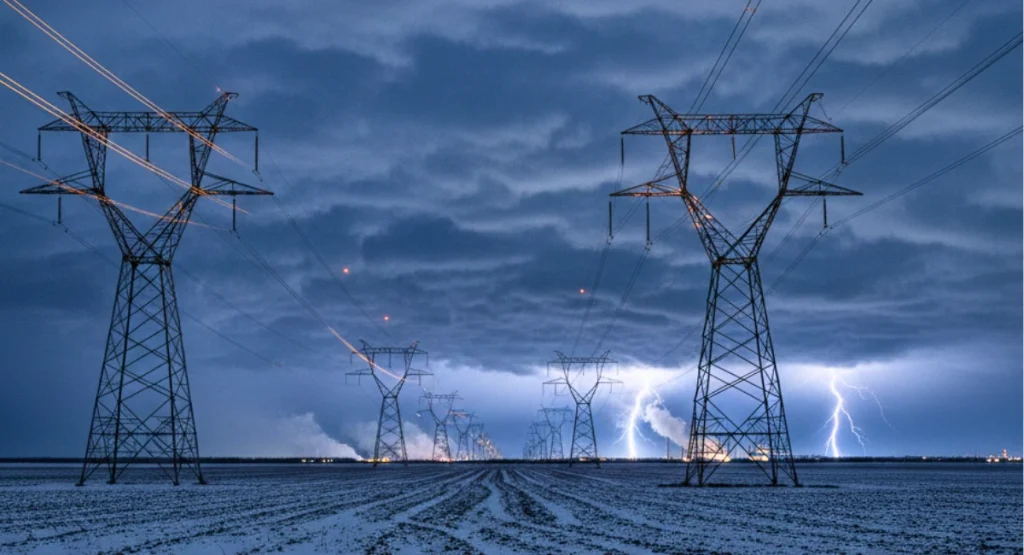
The U.S. power grid stands at a critical crossroads as aging infrastructure, climate volatility, and record energy demand threaten to test its limits this winter.
A Flashback That Still Haunts
I still remember the images from February 2021 — entire neighborhoods in Texas plunged into darkness, families burning furniture to stay warm, and a modern energy system buckling under the weight of one historic storm. That blackout wasn’t just a Texas crisis — it was a wake-up call for the entire U.S.
Now, as the 2025 winter season looms, the same question echoes again: Has America truly learned from its mistakes, or are we still one storm away from another national breakdown?
I’ve been tracking U.S. grid data and climate projections for months, and the findings paint a worrying picture — a system more interconnected than ever, but not necessarily more resilient.
The Warning Signs Are Already Flashing
According to the North American Electric Reliability Corporation’s (NERC) 2024–2025 Winter Reliability Assessment, nearly two-thirds of the U.S. and Canada face “elevated risks” of power shortfalls if extreme cold sweeps the continent again.
NERC highlights that the Midwest (MISO), Texas (ERCOT), and parts of the Southeast remain particularly exposed. Much of this stems from the same issues we saw four years ago — frozen gas lines, limited interregional power sharing, and infrastructure built for a milder century.
The U.S. Energy Information Administration (EIA) projects that electricity demand this winter could spike 6–8% higher than the seasonal average. With heating systems, EV chargers, and data centers all drawing power simultaneously, the grid’s “cushion” — or reserve margin — is razor-thin.
“Grid operators know the margin for error is shrinking,” a senior NERC analyst said in the report. “It only takes one storm to expose decades of underinvestment.”
In fact, @NERC_Official recently shared insights from its 2024–2025 Winter Reliability Assessment, highlighting the elevated reliability risks across multiple U.S. regions this winter.
Why the U.S. Grid Is So Vulnerable
When I looked into Department of Energy (DOE) infrastructure data, one number jumped out — over 70% of U.S. transmission lines are more than 25 years old. That’s older than most of today’s technology CEOs.
The fragility isn’t just about age. The system depends heavily on natural gas, which provides 40% of national electricity. But gas infrastructure is uniquely vulnerable to cold weather — pipelines freeze, compressor stations seize, and delivery networks stall.
It’s a domino effect: one plant fails, load surges elsewhere, and rolling blackouts begin. That’s exactly what happened in 2021, when frozen gas wells took down generation capacity across the Midwest and Texas.
In short, the U.S. power grid was designed for predictability, not volatility — and climate change doesn’t play by those rules anymore.
How Climate Change Is Rewriting Winter
At first, it sounds ironic — a warming planet creating colder winters. But the science checks out. According to climate scientists at NOAA
, Arctic warming is destabilizing the polar jet stream, allowing frigid air to spill south into the continental U.S. more frequently.
That means winters now swing wildly between warm spells and sudden deep freezes. For the grid, that volatility is deadly. Systems that handle 30°F drops in temperature struggle when it’s 0°F or below for days.
Extreme cold doesn’t just boost demand — it reduces generation efficiency, especially for gas and coal plants. So, as the climate warms overall, local extremes intensify — a paradox that’s rewriting how utilities plan for resilience.
What the Data Says
Let’s break this down with current numbers from NERC and EIA :
| Region | 2025 Risk Level | Primary Weakness | Risk Factor |
|---|---|---|---|
| ERCOT (Texas) | High | Frozen gas supply | 20% capacity loss risk |
| MISO (Midwest) | Elevated | Transmission bottlenecks | Limited regional backup |
| PJM (Mid-Atlantic) | Moderate | Aging plants | Heavy peak demand |
| ISO-NE (New England) | Moderate | LNG imports | Weather disruptions |
In a worst-case Arctic outbreak, the U.S. could lose 10–15% of available generation, translating to outages for millions.
As one analyst noted :
“If the temperature dips below design limits, Texas could again lose up to 20% of its gas generation — that’s not theoretical; it’s documented risk.”
Efforts to Reinforce the Grid
To its credit, the federal government isn’t standing still. The DOE launched the Grid Resilience and Innovation Partnerships (GRIP) program, funneling $3.5 billion into modernizing infrastructure and integrating renewables.
Meanwhile, FERC Order 881, taking effect in 2025, mandates utilities to improve real-time transmission line ratings, letting them carry more power safely during demand surges.
Some progress is visible — California is leading in battery storage, while New York is expanding offshore wind integration to support winter demand.
Still, as I spoke with grid engineers and energy managers, one sentiment kept repeating: “We’re improving fast, but climate is moving faster.”
The Department of Energy recently reaffirmed this commitment on X, emphasizing the need for a resilient, smarter grid capable of meeting modern energy challenges.
In theory, these initiatives sound like the right fix. But on the ground, many utilities still rely on legacy systems, manual load balancing, and aging substations — all weak spots in an increasingly digital, electrified nation.
What’s at Stake This Winter
This isn’t just about electricity — it’s about lives, economies, and national security.
During the 2021 Texas storm, over 200 people lost their lives, and damages topped $195 billion. The economic ripple extended for months — industries paused, homes froze, and supply chains broke.
A similar multi-state grid failure in 2025 could impact tens of millions, especially in regions where heating is essential for survival.
We’re not predicting collapse, but the margin for error has never been thinner.
The stakes aren’t abstract anymore. Each severe winter storm now doubles as a national stress test — one that the grid must pass, or risk catastrophic consequences.
My Analysis — Are We Prepared or Just Hoping?
The U.S. grid isn’t failing — it’s transforming. But transformation takes time, and time is exactly what extreme weather doesn’t offer.
From my analysis, resilience is improving — more investment, smarter forecasting, and renewable diversification are helping. Yet, the response speed still lags behind the pace of climate disruption.
We’re in a race between modernization and meteorology. And right now, the weather is winning by a nose.
If climate change is the new normal, then grid resilience isn’t a luxury — it’s survival.
It’s not just about preventing blackouts; it’s about ensuring the backbone of modern civilization doesn’t freeze under pressure.
Outlook for 2025 & Beyond
Looking ahead, both the DOE and EIA predict a critical decade for U.S. energy transformation.
By 2026, stricter weatherization standards and expanded battery storage may reduce regional outage risks by up to 30%. By 2030, decarbonization goals could align with a more distributed, renewable-heavy grid.
But that’s still years away.
As someone who’s followed climate data for over a decade, I can say this: we’ve learned to predict the storm — but we haven’t yet learned how to survive it.
Until infrastructure, regulation, and adaptation move in sync, each winter will test not just America’s power grid, but its ability to adapt to a changing planet.
Disclaimer :
This article is based on publicly available data from NERC, DOE, and NOAA as of November 2025. Actual outcomes may vary with future conditions. Content is for informational use only, not technical or policy advice.

Contents
- 1 The U.S. power grid stands at a critical crossroads as aging infrastructure, climate volatility, and record energy demand threaten to test its limits this winter.
- 2 A Flashback That Still Haunts
- 3 The Warning Signs Are Already Flashing
- 4 Why the U.S. Grid Is So Vulnerable
- 5 How Climate Change Is Rewriting Winter
- 6 What the Data Says
- 7 Efforts to Reinforce the Grid
- 8 What’s at Stake This Winter
- 9 My Analysis — Are We Prepared or Just Hoping?
- 10 Outlook for 2025 & Beyond
- 11 Disclaimer :