
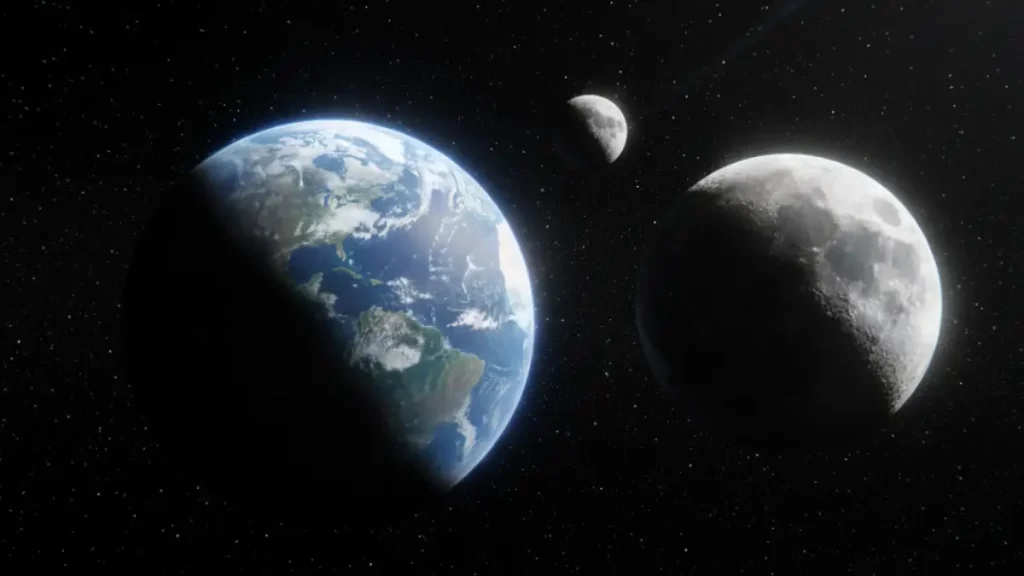
What if Earth had not one, but two moons?
That question sounds like science fiction — yet NASA has officially confirmed it’s true, at least for now. In a remarkable astronomical discovery, scientists have found a small asteroid orbiting in sync with our planet, behaving like a second moon.
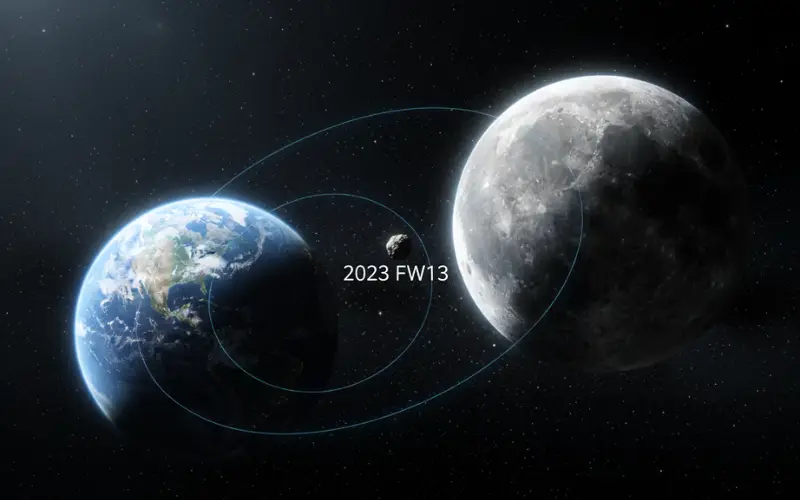
This cosmic companion, named 2023 FW13, isn’t a traditional moon. It doesn’t orbit Earth directly like our familiar lunar neighbor. Instead, it follows a unique path around the Sun — mirroring Earth’s orbit so precisely that it seems to accompany us through space.
Astronomers call it a “quasi-satellite”, and NASA’s Jet Propulsion Laboratory (JPL) confirms that this tiny celestial body has been traveling with Earth for centuries — since around 100 B.C. — and will continue doing so until at least 2083.
The discovery of 2023 FW13 not only expands our understanding of Earth’s gravitational neighborhood but also challenges what we define as a “moon.” It’s a scientific reminder that our solar system still holds surprises, even in the space closest to home.
What NASA Actually Found
NASA’s findings began with observations from the Pan-STARRS 1 telescope in Hawaii, one of the world’s most advanced sky survey systems. Astronomers initially thought they were tracking another small near-Earth asteroid. But when they analyzed its motion, something unusual emerged — it wasn’t just passing by Earth.
Instead, 2023 FW13 seemed to move with us, looping gently around our planet’s orbit every year. Using precise orbital models, NASA’s Jet Propulsion Laboratory confirmed that the asteroid’s trajectory is gravitationally locked in harmony with Earth’s motion around the Sun.
The asteroid is small — about 15 to 20 meters wide (roughly the size of a bus) — but its orbit is vast, stretching between 14 million and 24 million kilometers from Earth. Despite its distance, the asteroid’s timing and speed are so synchronized with our planet’s that it’s classified as a quasi-moon, or what some astronomers call a “co-orbital companion.”
What Makes This Second Moon So Unique
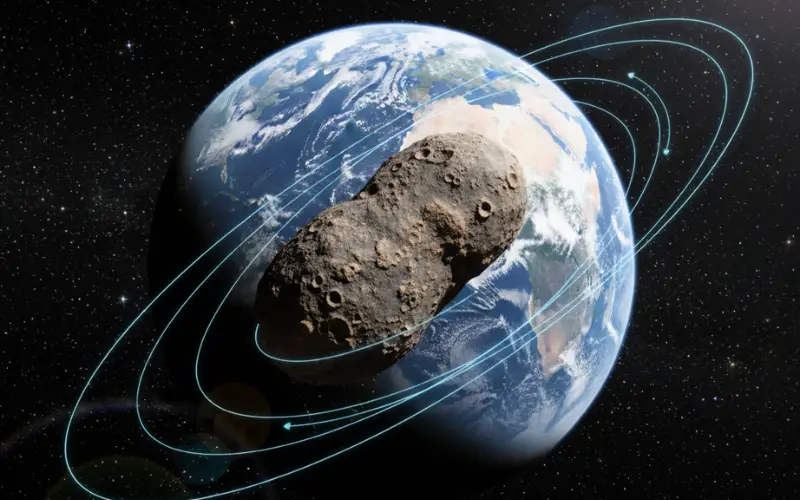
2023 FW13 is extraordinary because of its stability. Many quasi-moons have been discovered before — like Kamoʻoalewa (2016 HO3) — but most drift away or get disrupted by the gravitational forces of other planets.
This one, however, has been locked in orbit with Earth for over 2,000 years and will stay with us for at least another 60. NASA scientists describe it as the most stable quasi-satellite ever observed.
How It Differs from Our Real Moon
Although it’s often called Earth’s second moon, 2023 FW13 is nothing like the bright lunar disc we see each night.
The real Moon is huge — over 3,400 kilometers wide — and firmly bound by Earth’s gravity. It orbits once every 27.3 days, influencing tides, seasons, and even the planet’s stability.
In contrast, the second moon is tiny and faint, orbiting the Sun rather than Earth directly. It completes a lap around the Sun at nearly the same speed as our planet, staying just ahead or behind us.
From certain perspectives, it appears to loop around Earth in a gentle wave-like path — but in reality, it’s just shadowing our orbit.
While the real Moon is a permanent companion, this second moon is only temporary — destined to drift away by 2083. It doesn’t affect tides, climate, or daily life — but scientifically, it’s a treasure trove of insight.
Why Scientists Are Excited About the Discovery
NASA’s confirmation of a second moon might sound small, but it opens big possibilities.
Studying quasi-moons like 2023 FW13 helps scientists understand the gravitational balance that shapes planetary systems. These findings can improve our ability to predict asteroid paths, plan interplanetary missions, and even locate safe orbital zones for future spacecraft.
The discovery also provides clues about Earth’s early formation, when smaller bodies frequently shared orbits and collided — events that may have shaped both the Moon and our planet’s structure.
In the long run, learning how quasi-satellites behave could also help NASA design stable orbital platforms or waypoints for deep-space missions — especially those heading toward Mars or the asteroid belt.
As one NASA orbital dynamics expert put it:
“Objects like 2023 FW13 are nature’s laboratories. They let us test the laws of gravity without leaving home.”
Myths Meet Science — The Two Moons of Earth
For centuries, myths and legends have imagined Earth having more than one moon. Ancient civilizations saw twin lunar deities, and modern fiction often features planets with multiple satellites.
Now, thanks to NASA’s confirmation, that vision feels a little closer to reality. Even though this “second moon” is small, dark, and temporary, it proves that Earth’s orbit is more dynamic than we ever realized.
Why It Matters for the Future
NASA’s discovery of Earth’s second moon is more than just a headline — it’s a milestone in our understanding of orbital harmony.
Here’s why it matters:
- It expands our knowledge of near-Earth space.
- It improves asteroid tracking.
- It supports future missions.
- It deepens our cosmic awareness.
Two Moons, One Earth
For the next half-century, Earth will travel not alone, but with a quiet companion — a second moon moving gracefully through the darkness.
It’s not a visible spectacle or a myth reborn, but a scientific marvel — a natural example of balance, gravity, and harmony in motion.
Disclaimer: This article is for educational purposes only and is based on verified NASA data and astronomical research. Readers are advised to refer to official NASA updates for the latest information.