

For over half a century, biologists have been puzzled by a quiet paradox inside every green leaf:
If photosynthesis powers nearly all life on Earth, why isn’t it more efficient?
At the heart of this mystery lies a single enzyme — Rubisco, the molecular machine responsible for turning sunlight and carbon dioxide into the sugars that sustain ecosystems.
Despite being the most abundant protein on the planet, Rubisco has always been oddly clumsy: it works slowly and sometimes mistakes oxygen for carbon dioxide, wasting precious energy.
Now, an international team of scientists from the University of Cambridge, Australian National University, and Max Planck Institute of Molecular Plant Physiology has solved the riddle.
Now, an international team of scientists from the University of Cambridge, Australian National University, and Max Planck Institute of Molecular Plant Physiology has solved the riddle.
Their 2025 paper in Nature Plants reveals that Rubisco’s inefficiency isn’t an error of evolution — it’s a deliberate act of biological design.
“Rubisco’s slow speed is not a flaw,” explains Dr. Stefanie Müller of the University of Cambridge.
“It’s an evolutionary safeguard that trades speed for accuracy — ensuring the planet’s green engine runs smoothly, even under changing skies.”
The Puzzle That Stumped Scientists for 50 Years
Since the 1960s, plant scientists have known that Rubisco often grabs the wrong molecule.
When it accidentally binds oxygen (O₂) instead of carbon dioxide (CO₂), it triggers a wasteful reaction called photorespiration, slashing a plant’s efficiency by as much as 30 percent.
For decades, researchers tried to “fix” Rubisco through genetic engineering — speeding it up, copying it from algae, or tweaking its structure.
Every attempt failed. The enzyme refused to cooperate.
The reason, the new study shows, is simple: Rubisco never needed fixing.
It’s already tuned to maintain stability across shifting environments — from tropical rainforests to alpine tundra.
Meet Rubisco — The Enzyme That Both Feeds and Frustrates the Planet
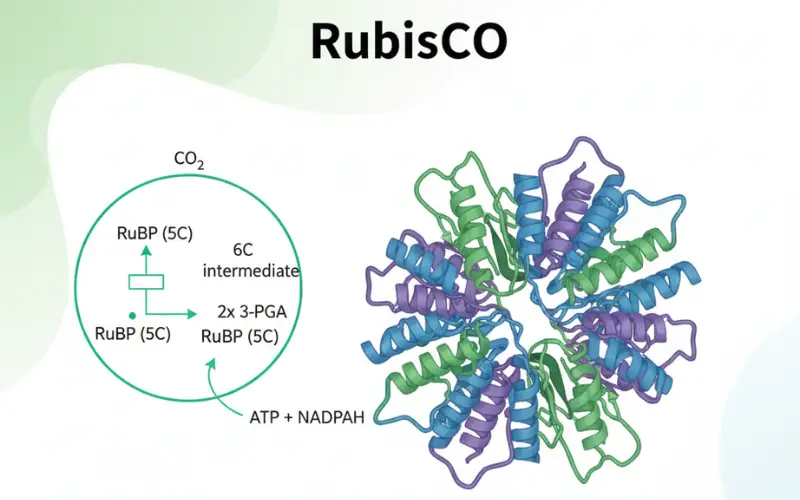
Rubisco — short for Ribulose-1,5-bisphosphate carboxylase/oxygenase — performs the first critical step in carbon fixation.
Each molecule captures CO₂ from the air and combines it with another compound to start the Calvin Cycle, ultimately creating the carbohydrates that feed all organisms.
Why? Because Rubisco works in a delicate, noisy chemical environment.
Too much haste, and it mistakes oxygen for carbon. Too much precision, and it slows to a crawl.
The Breakthrough That Changed Everything

In 2025, using cryo-electron microscopy (cryo-EM), the research team captured Rubisco’s structure in real time — seeing it at near-atomic resolution for the first time.
They discovered that Rubisco works hand-in-hand with helper proteins called Rubisco activases .
These molecular “mechanics” constantly detect and fix Rubisco’s mistakes, resetting the enzyme whenever it gets jammed.
Through this mechanism, plants maintain a steady flow of photosynthesis — a self-correcting loop that scientists now describe as “the heartbeat of the leaf.”
Slow by Design — Nature’s Perfect Balancing Act
The cryo-EM imagery revealed why Rubisco stayed “imperfect.”
The enzyme’s shape favors accuracy — ensuring that every CO₂ molecule is correctly captured — even if it means moving slower.
During Earth’s early history, the atmosphere contained far more CO₂ than oxygen, so Rubisco had an easy job.
As oxygen levels rose over billions of years, Rubisco evolved tighter chemical filters to avoid mistakes.
Speed sacrificed, precision gained.
In evolutionary terms, Rubisco’s slowness became a survival strategy.
How This Discovery Could Revolutionize Climate Solutions
Rubisco currently fixes about 200 billion tons of CO₂ each year, keeping our atmosphere stable.
But with climate change accelerating, scientists see enormous potential in enhancing this process.
By understanding Rubisco’s design, researchers can now:
- Engineer super-efficient crops that capture more carbon and yield higher food output.
- Develop synthetic photosynthesis systems that store solar energy directly as fuel.
- Create resilient plants capable of thriving in hotter, drier conditions.
The “Heartbeat” of Photosynthesis
The Cambridge-led team visualized how Rubisco activases form a ring around the enzyme, twisting open its core and releasing trapped molecules — a process that happens thousands of times per second.
It’s the first time scientists have seen the photosynthetic repair cycle in motion.
This constant molecular dance ensures that plants can handle environmental stress, from sudden sunlight bursts to droughts.
A New Era in Plant Science
The discovery has been hailed as one of the most important advances in plant biology in 50 years.
NASA’s climate research team and the Royal Botanic Gardens, Kew, called it a “milestone for both agriculture and planetary modeling.”
“Understanding Rubisco changes how we model carbon balance in Earth-system simulations,”
wrote Dr. Laura Gibson, climate scientist at NASA Goddard Institute.
The Future of Engineered Photosynthesis
The next frontier is photosynthetic engineering — using AI and biotechnology to redesign nature’s light-harvesting systems.
Ongoing projects at the Salk Institute and ANU’s Centre for Excellence in Plant Energy Biology are already testing hybrid Rubisco versions that combine the speed of algal enzymes with the precision of plant ones.
Early computer models suggest up to 40% increases in crop efficiency and 20% higher CO₂ capture rates.
Nature’s Greatest Teacher
This discovery doesn’t just close a scientific chapter — it opens a philosophical one.
Rubisco’s story reminds us that nature often values stability over speed, balance over brilliance.
Disclaimer: This article is for educational purposes only and is based on credible scientific research. Readers should refer to official studies or experts for detailed scientific guidance.
Contents
- 1 The Puzzle That Stumped Scientists for 50 Years
- 2 Meet Rubisco — The Enzyme That Both Feeds and Frustrates the Planet
- 3 The Breakthrough That Changed Everything
- 4 Slow by Design — Nature’s Perfect Balancing Act
- 5 How This Discovery Could Revolutionize Climate Solutions
- 6 The “Heartbeat” of Photosynthesis
- 7 A New Era in Plant Science
- 8 The Future of Engineered Photosynthesis
- 9 Nature’s Greatest Teacher