Tehran’s ongoing water rationing isn’t just a local crisis — it’s a sign of an escalating water conflict across the Middle East, driven by drought, climate stress, and decades of mismanagement.
A Crisis Dripping Into Conflict
This week, as I tracked reports from Tehran’s municipal water authority, residents across the Iranian capital faced another round of water cuts — some lasting hours, others stretching through the night. For many, turning on the tap has become a guessing game.
Authorities call it “temporary rationing.” But the pattern, repeated across Iran’s major cities, tells a deeper story: Tehran’s crisis isn’t just about drought — it’s a warning for the entire Middle East.
Across the region, shrinking rivers, falling reservoirs, and aquifer depletion are redefining national security. The “water war” isn’t declared with weapons, but with pumps, pipelines, and policy failures.
As I analyzed recent data, it became clear that Tehran’s water shortage is part of a larger chain reaction — one that stretches from Turkey’s dams to Jordan’s desalination plants.
Inside Tehran’s Thirst
Tehran, home to nearly 15 million people, depends heavily on reservoirs and inter-basin water transfers from surrounding provinces. But these lifelines are drying fast. After years of weak rainfall, coupled with rapid urban expansion, the city’s underground aquifers have sunk to record lows.
The Water and Wastewater Company of Tehran recently acknowledged that over 25% of total supply is lost to leaks and aging infrastructure as reported by Tehran Times. In several districts, water pressure drops to near zero during peak hours. For many households, rotational cuts are the new normal.
“We can’t even wash clothes or cook on schedule anymore,” said a resident from southern Tehran in a televised interview. “Every night, we fill buckets just in case.”
Iranian officials cite “unprecedented climate stress,” but internal studies show that decades of over-extraction, inefficient irrigation, and urban sprawl have brought the system to the brink. The capital’s water debt — the overuse of resources beyond natural recharge — is now impossible to ignore.
Beyond Tehran: A Mirror for the Middle East
Tehran’s plight reflects a regional trend that could reshape the geopolitics of water. From the Tigris and Euphrates to the Jordan River Basin, the Middle East’s shared rivers are running thinner — and patience shorter as noted in a 2023 UN report.
1. The Tigris–Euphrates Basin
Upstream dams in Turkey and Syria have restricted flows to Iraq, whose southern marshes are drying. Once the cradle of Mesopotamian civilization, this region is now a patchwork of cracked fields. Farmers have migrated to cities, fueling unemployment and unrest.
2. The Jordan River Basin
Israel, Jordan, and Palestine have long relied on delicate water-sharing agreements. As rainfall patterns change, those deals are strained. Jordan — one of the most water-poor nations on Earth — increasingly depends on desalination and water swaps, a fragile solution in a volatile neighborhood.
3. Iran’s Own Basins
Inside Iran, the Zayandeh Rud River in Isfahan and Lake Urmia in the northwest tell similar stories. Zayandeh Rud’s dry bed has become a symbol of political tension between farmers and authorities. Meanwhile, Lake Urmia — once the largest saltwater lake in the Middle East — has shrunk to less than one-third of its original size.
4. The Gulf States
Across the Gulf, desalination plants keep taps running, but at a high cost. These systems depend on fossil fuels and electricity. Any power failure or fuel disruption could instantly become a water crisis — turning an energy shock into a survival threat.
The Climate Multiplier
What links these flashpoints is not just poor management — it’s the climate factor. The Middle East is warming nearly twice as fast as the global average, according to regional climate models.
Global temperature data reveals the Middle East among the world’s hottest and fastest-warming zones.
As I examined meteorological records, one clear pattern emerged: the region now faces longer droughts punctuated by intense flash floods. Ironically, when rain finally arrives, parched soil and silted reservoirs prevent proper storage. This “flash-flood paradox” means water vanishes as quickly as it falls.
These extremes feed a dangerous cycle: heat drives demand, demand deepens scarcity, and scarcity heightens tension. By 2030, several countries could see 30–40% less renewable water per capita, the UN warns.
The Human & Political Fallout
Behind the statistics are human stories — farmers abandoning ancestral lands, children missing school due to waterborne illness, cities grappling with ration protests.
In Khuzestan Province, southwest Iran, demonstrations over water shortages have turned violent multiple times. Across borders, Iraq has seen similar unrest, as have parts of Syria and Jordan. Experts now refer to “water refugees” — families moving not because of war, but because their wells ran dry as noted by the UN Environment Programme.
The geopolitical stakes are just as severe. When rivers and aquifers cross borders, scarcity can become a trigger. For instance, Turkey’s control of upstream dams gives it leverage over downstream states. Iran, too, faces diplomatic tension with Afghanistan over the Helmand River, whose flow supports millions in Iran’s Sistan region.
“The next Middle Eastern conflict might not start with oil — it might start with water,” a regional analyst told Al-Jazeera earlier this year.
A Legacy of Mismanagement
Iran’s water crisis, like its neighbors’, is not purely natural. For decades, governments pushed self-sufficiency in agriculture, promoting water-intensive crops such as rice and wheat even in arid zones. Subsidized water prices encouraged waste, while poor maintenance bled infrastructure dry.
In Tehran, decades of drilling deeper wells masked the real crisis. But now, as groundwater tables collapse, land subsidence is visible — neighborhoods in southern Tehran have sunk by over 20 centimeters in some areas, according to geological surveys.
The same pattern repeats region-wide: short-term fixes replacing sustainable planning.
Can the Middle East Avert a Water War?
Solving this crisis requires cooperation in a region often defined by conflict. Yet, there are hopeful signals.
- Smarter city management: Iran and Jordan are experimenting with digital water-metering and leak detection to reduce urban losses.
- Agricultural reform: Israel’s drip-irrigation models and UAE’s hydroponics show water-efficient farming can scale.
- Desalination with renewables: Saudi Arabia’s NEOM project aims to power desalination entirely via solar, cutting carbon costs.
Solar-powered desalination projects like Dubai’s Hassyan plant show how renewable energy is reshaping freshwater access across the Gulf.
- Regional dialogue: Though fragile, initiatives like the Middle East Green Initiative include water conservation as a core agenda according to the United Nations reports.
Experts argue that transparency and shared data — knowing how much water each basin holds, and who uses it — could be the key. But cooperation demands trust, and trust is often the rarest resource in the Middle East.
A Regional Wake-Up Call
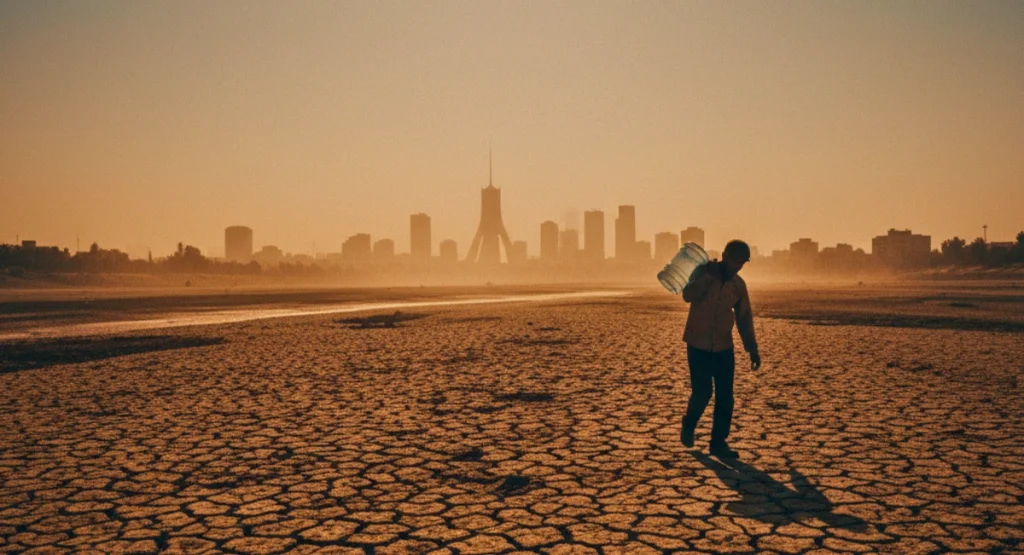
As I write this, Tehran’s reservoirs sit at barely half their historical average. Water trucks roam some districts; elsewhere, residents store bottles as if preparing for a siege.
This is not an isolated drought or a one-season hardship. It’s a glimpse into the future of the Middle East — a region where water will define power, shape alliances, and test survival.
Water, once a symbol of life, is becoming a symbol of inequality. The question isn’t whether a “water war” is coming — it’s whether we can stop one that has already begun.
Disclaimer :
The views and interpretations presented are drawn from current research and regional reports. NatureSignals aims to provide fact-based, unbiased coverage of environmental and geopolitical issues.

Contents
- 1 Tehran’s ongoing water rationing isn’t just a local crisis — it’s a sign of an escalating water conflict across the Middle East, driven by drought, climate stress, and decades of mismanagement.
- 2 A Crisis Dripping Into Conflict
- 3 Inside Tehran’s Thirst
- 4 Beyond Tehran: A Mirror for the Middle East
- 5 1. The Tigris–Euphrates Basin
- 6 2. The Jordan River Basin
- 7 3. Iran’s Own Basins
- 8 4. The Gulf States
- 9 The Climate Multiplier
- 10 The Human & Political Fallout
- 11 A Legacy of Mismanagement
- 12 Can the Middle East Avert a Water War?
- 13 A Regional Wake-Up Call
- 14 Disclaimer :