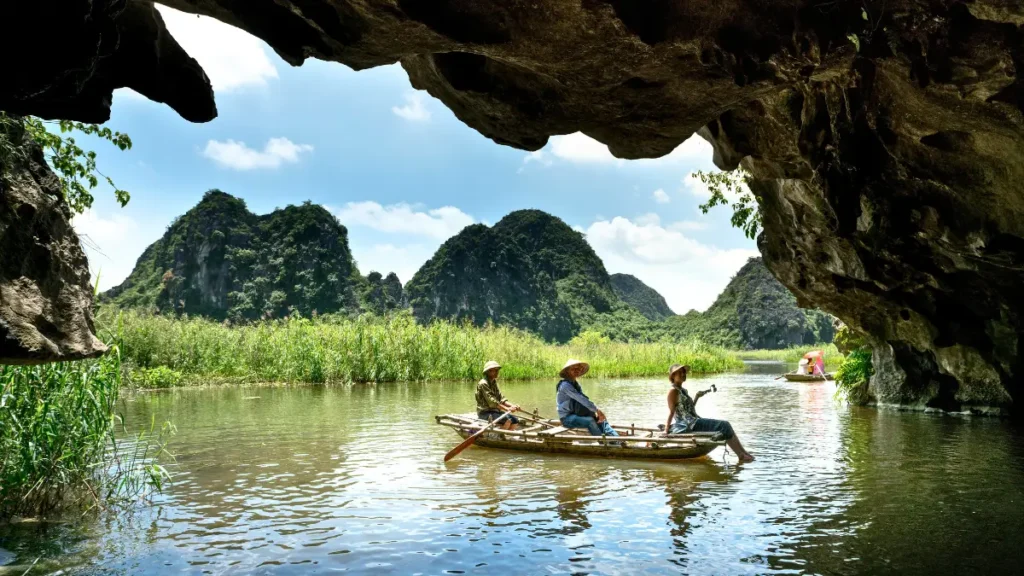
Deep inside Vietnam’s remote mountains lies the world’s largest cave, a self-contained prehistoric ecosystem with its own rainforest, clouds, rivers, and species found nowhere else, now drawing global scientific attention.
A Hidden World Beneath Vietnam: The U.S. Science Community Takes Notice
For American geologists, climate researchers, and explorers, Vietnam’s world’s largest cave, Hang Son Doong: has rapidly become one of the most intriguing natural discoveries of the century.
Inside its massive chambers lie clouds forming in darkness, 100-foot trees growing underground, and species that evolved with almost no contact with the outside world.
While the cave sits in Southeast Asia, its scientific value is global. U.S. cave ecologists, NASA climate analysts, and biodiversity researchers now consider Son Doong a living laboratory, a window into prehistoric Earth.
A Cave Big Enough to Hold a Skyscraper
Hang Son Doong stretches more than 5 kilometers (3.1 miles) and reaches heights comparable to a 60-story building.
Its volume is over 414 million cubic feet, makes it the largest known cave on Earth.
What makes it extraordinary is not just its size but its atmospheric behavior:
- Fog condenses into clouds underground
- Temperature shifts create a microclimate
- Humidity levels mimic tropical rainforests
It is, in effect, a weather system under the Earth’s surface, something rarely documented anywhere else.
A Rainforest Growing 600 Feet Underground
Centuries ago, parts of the world’s largest cave ceiling collapsed, creating massive dolines, natural skylights that allow sunlight to reach the cave floor.
This gave rise to one of the planet’s strangest ecosystems:
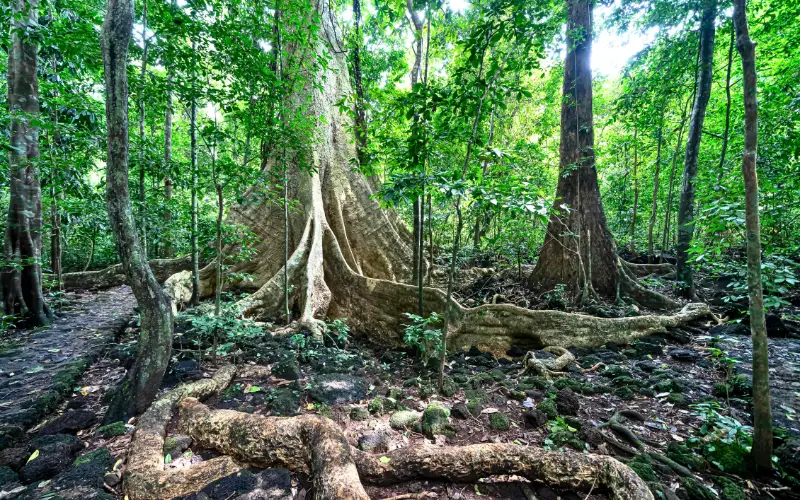
Underground Rainforest Highlights
- Trees growing up to 30 meters (98 feet) tall
- Moss-covered slopes resembling untouched jungles
- Photosynthetic plants thriving where no forest should exist
Species Found Nowhere Else on Earth
Inside the world’s largest cave, researchers have counted more than 250 unique plant and animal species. Many evolved in complete darkness.
These include:
- Eyeless fish
- Transparent crustaceans
- Rare cave-adapted fungi
- Insects shaped by millions of years of isolation
In outer chambers, monkeys and birds occasionally descend through openings, creating brief encounters between surface species and underground life.
U.S. evolutionary scientists compare Son Doong to a natural version of a sealed habitat experiment, a place where adaptation unfolds without human interference.
A Geological Story Millions of Years in the Making
American geologists studying Son Doong point to fossilized corals on the cave walls as evidence that this region was once submerged beneath an ancient sea.
The cave formed as underground rivers carved their way through limestone over 2–5 million years.
Two rivers: Khe Ry and Rao Thuong are continue to flow inside, forming pools, waterfalls, and fast-moving subterranean streams.
These features make it a rare site where:
- Water activity
- Geological erosion
- Atmospheric behavior
- all converge inside one massive underground system.
The Great Wall of Vietnam — A Natural Barrier
The Great Wall of Vietnam: a natural barrier protecting unexplored chambers.
Toward the end of the cave stands the Great Wall of Vietnam, an 80-meter-tall limestone barrier blocking access to deeper chambers.
Beyond it lie sections largely unexplored, partly because Vietnam restricts access to protect the fragile environment.
Today, only one licensed expedition group is allowed entry. Visitors must pass physical tests equivalent to those required for moderate military training.
The aim is conservation, not tourism.
What Makes This Cave Important for U.S. Science?
Even though the cave is in Vietnam, it’s now an important field of study for U.S.-based researchers because it offers:
1. A Model of Prehistoric Earth
The world’s largest cave mirrors climate and ecological conditions that existed millions of years ago.
2. Insights Into Climate Stability
Its self-contained climate system helps scientists study microclimates and atmospheric behavior.
3. Clues for Biodiversity Conservation
Understanding isolated ecosystems can guide U.S. conservation strategies for caves and protected areas.
4. A Natural Blueprint for Resilience
Son Doong shows how ecosystems survive long-term isolation, a key question in modern conservation biology.
Fragility Under Threat
Even limited tourism can:
- disrupt humidity cycles
- introduce contaminants
- disturb rare species
- change airflow patterns
Scientists warn that once this ecosystem is damaged, it may never recover.
The U.S. National Cave and Karst Research Institute has already partnered with international teams to monitor these impacts.
A Final Window Into an Untouched World
The world’s largest cave is a reminder of how little of Earth’s hidden ecosystems we truly understand.
For U.S. scientists, Son Doong is not just a global wonder — it is a rare opportunity to study nature in its purest form.
Disclaimer: “This article is for educational and informational purposes based on current scientific and exploration data. Cave access, safety rules, and environmental guidelines may change; readers should confirm details with official authorities.”

Contents
- 1 A Hidden World Beneath Vietnam: The U.S. Science Community Takes Notice
- 2 A Cave Big Enough to Hold a Skyscraper
- 3 A Rainforest Growing 600 Feet Underground
- 4 Underground Rainforest Highlights
- 5 Species Found Nowhere Else on Earth
- 6 A Geological Story Millions of Years in the Making
- 7 The Great Wall of Vietnam — A Natural Barrier
- 8 What Makes This Cave Important for U.S. Science?
- 9 Fragility Under Threat
- 10 A Final Window Into an Untouched World